AUTOMOTIVE REFRIGERANT

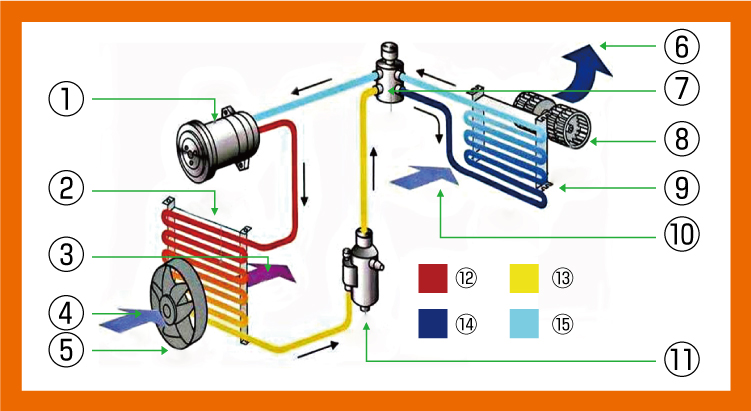
■ Automotive refrigerants (commonly known as refrigerant gas) are mostly Freon, which play a crucial role in the vehicle air conditioning system. The automotive refrigeration system mainly consists of a compressor, condenser, evaporator, and expansion valve.
■ Among them, the compressor is designed to compress the refrigerant at a low temperature and under a low pressure into a gas at a high temperature and under a high pressure, thereby raising the refrigerant temperature and pressure. The condenser is designed to cool the refrigerant at a high temperature and under a high pressure down to the liquid under a high pressure. The evaporator is designed to evaporate the liquid refrigerant under a high pressure to the gas at a low temperature and under a low pressure, thereby absorbing the heat inside the car compartment. The throttle valve is designed to control refrigerant flow and thereby regulate the cooling performance of the automotive air conditioner. Therefore, refrigerant quality has a direct influence on the cooling performance of automotive air conditioners.
■ Freon refrigerants are generally classified into three categories: chlorofluorocarbons (CFCs), hydrochlorofluorocarbons (HCFCs), and hydrofluorocarbons (HFCs).
1. Freon refrigerants containing chlorine but no hydrogen are called CFCs, such as R12 (CF₂Cl₂) and R11 (CFCl₃). These types of refrigerants have a severe ozone-depleting effect.
2. Freon refrigerants containing both chlorine and hydrogen are called HCFCs, such as R22 (HCF₂Cl). These refrigerants have a weaker ozone-depleting effect compared with CFCs.
3. Freon refrigerants containing fluorine but no chlorine are called HFCs, such as R134a. These refrigerants do not cause ozone depletion, so they are also known as environmentally friendly refrigerants.
Product Introduction and Advantages:
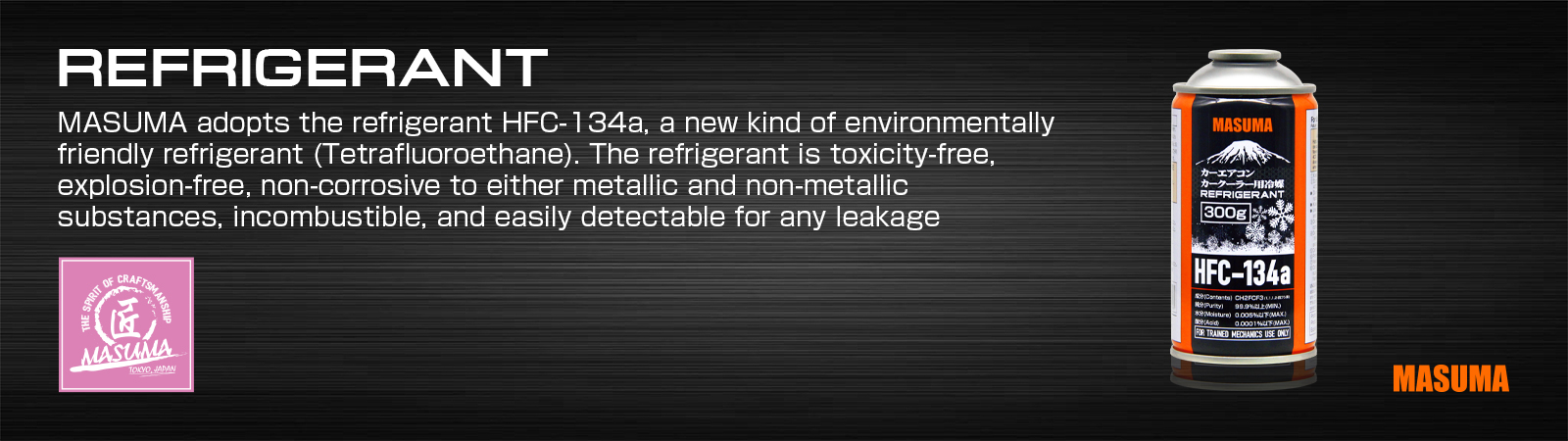
■ MASUMA adopts the refrigerant HFC-134a, a new kind of environmentally friendly refrigerant (Tetrafluoroethane). The refrigerant is toxicity-free, explosion-free, non-corrosive to either metallic and non-metallic substances, incombustible, and easily detectable for any leakage; it features a chemical stability, no damage to lubricant and a high latent heat of evaporation; its ozone depletion potential (ODP) is 0; its holistic global warming potential (HGWP) is 0.3; in short, it presents an excellent environmental protection performance and does no harm to the environment. Applicable to automotive air conditioners, HFC-134a has a standard evaporation temperature of -26.5℃ and a freezing point of -101℃, and thus belongs to those refrigerants at a moderate temperature.

Can HFC-134a be interchanged with other refrigerants?
■ No! Refrigerant interchange will severely compromise both cooling efficiency and service life of the machine, disable the refrigeration device in the air conditioner, jam the compressor, crack both the condenser and refrigeration pipeline, and cause other failures. The refrigerant, the seal, the rubber ring, and the desiccant of air conditioning equipment vary by vehicle model.
Why does HFC-134a flow out as watery liquid?
■ HFC-134a has a boiling point of- 26.1 °C and therefore exists in a gaseous form at the ambient temperature and under an ambient pressure. The refrigerant adopted by us is filled into a tank under pressurization, and some part of the gas will become liquid under pressure. Therefore, 134a in a normal tank exists in both gaseous and liquid forms. As we open the tank, 134a in the gaseous form will be emitted first; if the tank opening faces upside down, 134a in a liquid form will be released, too. In this case, we may notice 134a in a watery liquid.
Cautions!
■ During the 134a release process, no tank opening shall face a human body part. 134a in the liquid form will quickly vaporize after release, and such gasification process will absorb heat around quickly, thus causing frostbite.
■ The refrigerant filling operation shall only be conducted by a professional refrigerant-filling operator.
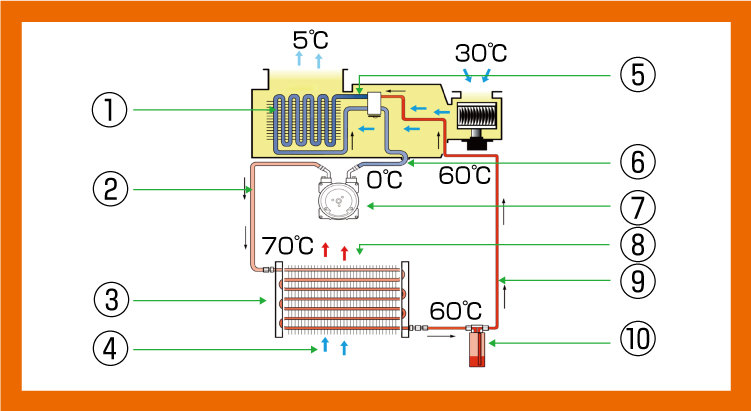
THE WORK MECHANISM ON AIR CONDITIONING COOLANT CIRCULATION SYSTEM

Maintenance Tips
■ Automotive refrigerant refilling is appropriate for once every 2 to 3 years. The operator shall pay close attention to the refilling amount all the time because excessive refilling may cause an abnormal air conditioning system;
1. Result in the pressure increment inside the air conditioning system, trigger the high pressure alarm from the automotive air conditioning system, and interrupt the compressor operation frequently, thus damaging the compressor if those abnormalities last for a long;
2. Exacerbate the cooling performance;
3. Damage the components of the air conditioner;
4. Crack the automotive air conditioning pipeline;

■ The continuously increasing car ownership in quantity has boosted the constant development in automotive air conditioners. It has become an indispensable part of our driving and traveling while having brought more comfort to our driving and riding experience. HFC-134a refrigerant by MASUMA works as the core of the air conditioning system and offers the guarantee for us to continue enjoying the comfort from the vehicle by virtue of its excellent and stable performance.