









 Home
Home
 Share
Share


1. Understanding the Control Arm: Your Suspension's Dynamic Link
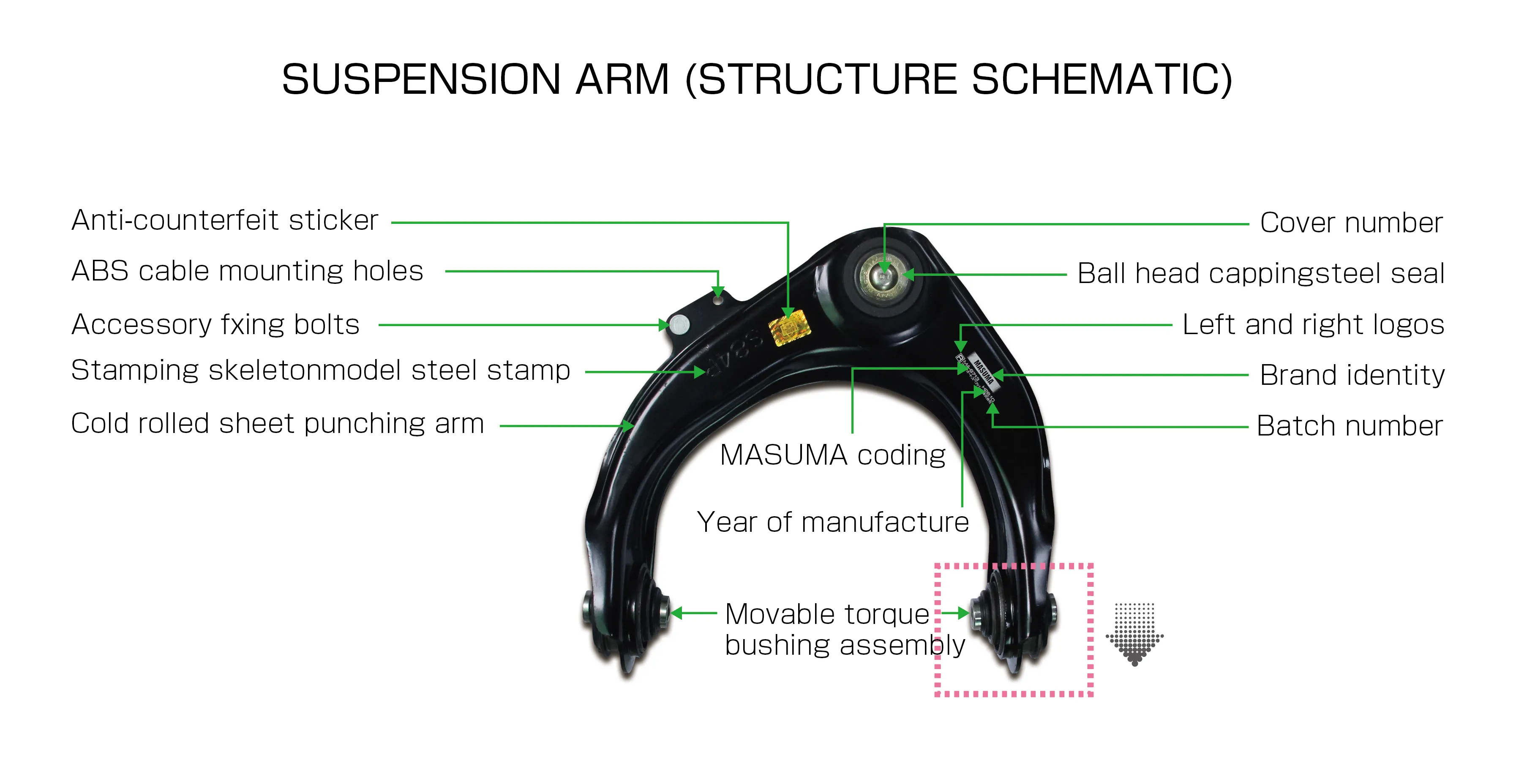
The control arm is a fundamental structural component in your vehicle's front suspension. Rather than just a static connection, it serves as a dynamic hinge that links the moving wheel assembly to the vehicle's rigid subframe. One end pivots on rubber-insulated bushings attached to the frame, while the outer end secures to the steering knuckle (spindle) via a flexible ball joint.
Depending on the suspension geometry:
Double Wishbone Configurations: Utilize both an upper and lower control arm to actively manage camber angles during cornering and vertical wheel movement.
MacPherson Strut Configurations: Eliminate the upper control arm, relying on a reinforced strut assembly and a single lower control arm to compact the system footprint.
In both front suspensions and independent rear suspension (IRS) systems, control arm integrity directly governs tire contact, alignment stability, and steering precision.
2. Comparing Suspension Architecture: Wishbone vs. Strut Systems
Engineers select different control arm setups to balance handling performance, space efficiency, and manufacturing costs:
| Suspension Design | Mechanical Architecture | Key Advantages & Applications |
|---|---|---|
| Double Wishbone System | Employs dual parallel or unequal-length control arms to distribute lateral forces. | Exceptional lateral rigidity and camber control; preferred in sports cars, premium sedans, and rugged SUVs. |
| MacPherson Strut System | Uses a solitary lower control arm paired with an upper dampening strut assembly. | Space-saving design, reduced unsprung weight, and lower production cost; standard across most modern passenger vehicles. |
3. Core Components Working in Harmony
Watch our short video below to see MASUMA control arms in action and learn about their engineered precision.
A control arm operates within an interconnected system comprising four key mechanical elements:
• Control Arm Bushings: Flexible rubber or polyurethane mounts connecting the arm to the chassis. Industry-leading aftermarket manufacturers like MASUMA engineer premium high-density rubber compounds that resist cracking, oil degradation, and structural deformation, ensuring whisper-quiet ride comfort.
• Ball Joints: Spherical joints connecting the control arm to the wheel spindle. Featuring hardened steel balls and high-durability dust boots, quality ball joints facilitate simultaneous steering articulation and vertical wheel travel without binding.
• Coil Springs: Resting in engineered spring seats on the control arm, coil springs support vehicle curb weight and absorb road shock forces.
• Alignment Adjustment Bolts: Eccentric bolts mounted at frame connections allow technicians to fine-tune camber and toe angles during alignment services.
4. Common Signs of Control Arm Wear and Failure
Due to constant road impact, control arm bushings and ball joints degrade over time. Watch for these warning signs:
• Clunking or Knocking Noises: Metallic popping or squeaking sounds when traveling over speed bumps, potholes, or rough pavement.
• Steering Instability & Steering Wheel Vibration: Excessive play in worn bushings allows wheel oscillation, causing highway steering wheel shimmy and vehicle pulling.
• Premature or Uneven Tire Wear: Accelerated tread wear along the inner or outer tire shoulders due to shifting suspension alignment parameters.
5. Maintenance & Quality Replacement: The MASUMA Advantage
When replacing worn suspension components, choosing high-precision aftermarket parts is essential. Premium chassis components from brands like MASUMA offer OE-matching fitment, reinforced steel/aluminum arm construction, and pre-greased, sealed ball joints. Replacing compromised control arms restores original handling dynamics, ensures road safety, and protects your tire investment.
 Previous Article