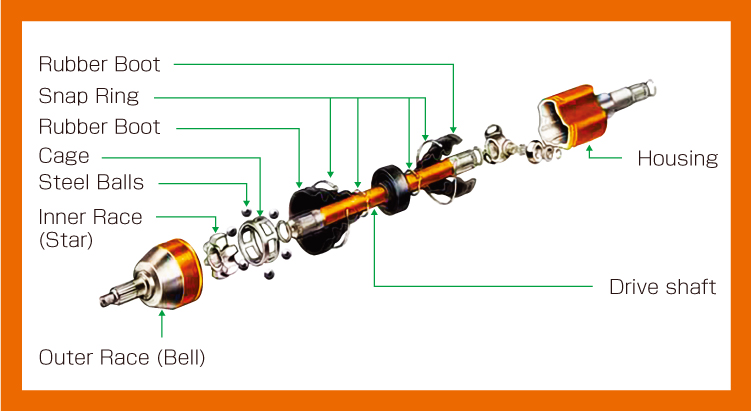
DRIVE SHAFT

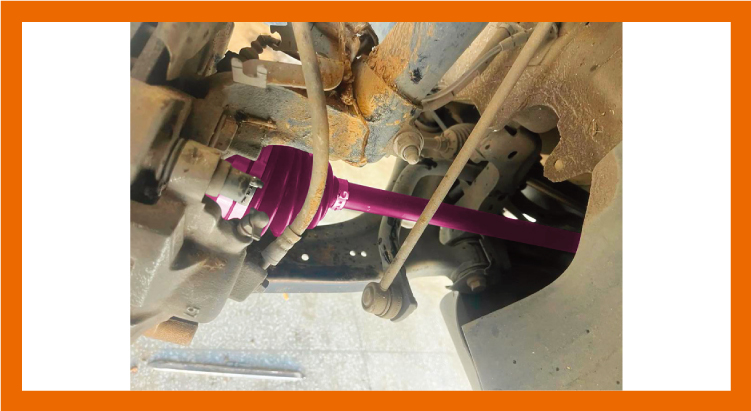
■ The half shaft assembly is a critical component of the automotive drivetrain, primarily transmitting power from the transmission or differential to the drive wheels. Comprising a high-strength steel half shaft, constant velocity (CV) joints, boots, grease, and fasteners, it accommodates angular changes during steering and suspension articulation, ensuring smooth power delivery. This assembly is widely used in front-wheel-drive, rear-wheel-drive, and all-wheel-drive vehicles.
■ As a vital link in power transmission, the performance of the half shaft assembly directly affects the vehicle’s power performance, energy economy, and handling stability. In conventional internal combustion engine vehicles, it must withstand the engine’s full torque output. In new energy vehicles, however, the higher instantaneous torque of electric motors imposes even more stringent strength requirements on the assembly.

■ During operation, the half shaft assembly can freely articulate within a ±45° range thanks to the special structural design of the CV joints, accommodating relative position changes during steering and suspension travel. Its key performance characteristics include: high torque transmission capacity (up to 5,000 N·m), excellent NVH performance (radial runout controlled within 0.8 mm), good environmental adaptability (operating temperature range: -40°C to 150°C), and long service life (design life typically exceeds 200,000 km).
Product Description
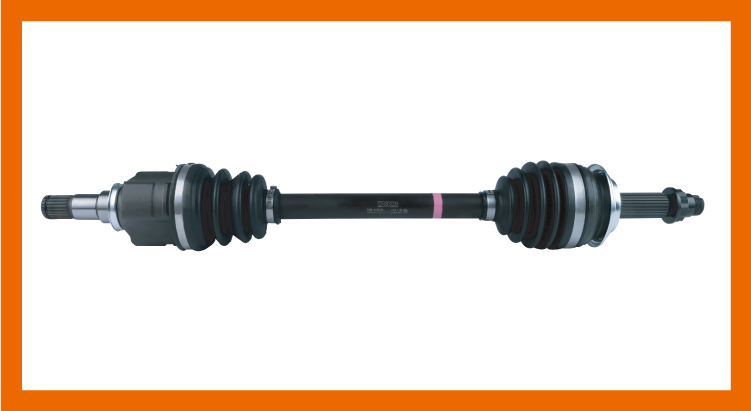
■ Half Shaft Body: The primary load-bearing component of the assembly, available in solid and hollow configurations. Commercial vehicles generally use solid shafts for their high load capacity and deformation resistance, while passenger cars tend to use hollow shafts, achieving outstanding weight reduction, lowering unsprung mass, and improving handling agility. The shaft body is forged from high-strength alloy steel.
■ Inner and Outer CV Joints (Constant Velocity Joints): Core functional components of the half shaft. The inner CV joint connects to the differential and handles power input, while the outer CV joint connects to the wheel hub and delivers power output. Together, they continuously adapt to wheel steering angles and suspension movement, ensuring uninterrupted power transmission during cornering and over uneven road surfaces.
■ Boots: Made of aging-resistant rubber, the boots form a tight seal that completely encloses the CV joints. They block the ingress of dirt, water, and dust, prevent grease leakage, and protect the joints from wear and binding.
■ Special Grease: Packed inside the CV joints, this grease offers high temperature resistance, anti-washout properties, and wear resistance. It continuously lubricates the joint balls and raceways, reducing frictional losses, noise, and wear.
■ Associated Fasteners: Includes snap rings, shims, nuts, and other accessories, manufactured to precise specifications for a direct fit with original mounting points. They secure the assembly structure, prevent loosening or detachment while driving and ensure installation stability.
Product Strengths
■ MASUMA half shaft assemblies offer the following key advantages:
■ Enhanced Driving Experience and Vehicle Stability: When cornering, the left and right wheels require different power levels. MASUMA half shaft assemblies ensure even power distribution, resulting in a smoother, more refined driving experience while maintaining vehicle smoothness and stability.
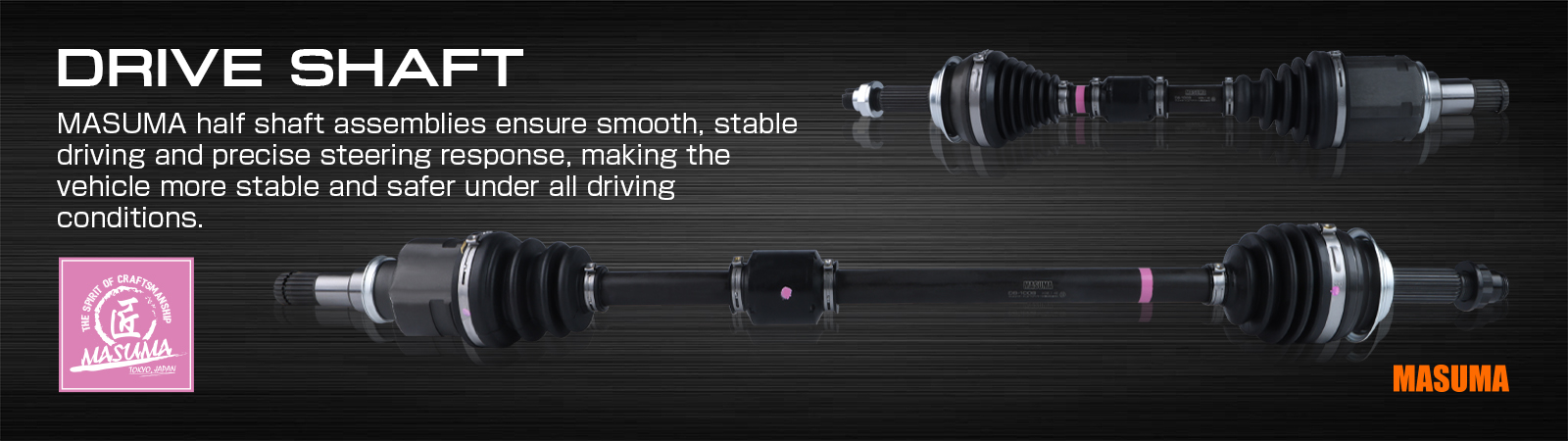
■ Improved Handling Performance: Under normal operation, MASUMA half shaft assemblies ensure smooth, stable driving and precise steering response, making the vehicle more stable and safer under all driving conditions.
■ Reduced Failures: MASUMA half shaft assemblies significantly reduce issues such as vehicle pulling and steering wheel vibration caused by damage, thereby minimizing safety risks associated with mechanical failures and improving overall vehicle performance and reliability.

Products (structural schematic)
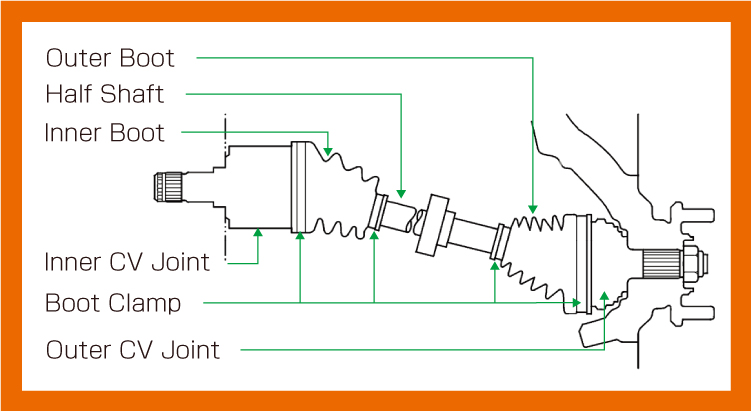
■ Core components of modern half shaft assembly:
■ Half Shaft Body: Forged from high‑strength alloy steel; some premium models feature a hollow design to reduce weight. The surface undergoes induction hardening to achieve a hardness of HRC 58–62.
■ CV Joint Set: Includes the inner and outer CV joints, ensuring smooth power transmission across all steering angles.
■ Sealing System: Utilizes TPEE (thermoplastic polyester elastomer) boots with excellent weather resistance, combined with a specially designed sealing structure to effectively prevent grease leakage and contaminant ingress.


Common Faults and Diagnostic Methods
■ Common failures of half shaft assembly include damaged bearings, grease leakage, and clicking noises when turning. When these occur, the assembly should be replaced promptly. The replacement procedure includes removing the wheel hub, securing the brake disc, and removing the nut connecting the half shaft. When installing a new half shaft, ensure that the inner and outer CV joints are connected smoothly and conduct a thorough inspection to guarantee installation quality.
■ Clicking Noise When Turning: A rhythmic clicking sound from the wheel area during low-speed steering or U‑turns that disappears when driving straight. This is most often caused by outer CV joint wear, boot damage leading to grease loss, and ingress of dirt and sand that abrades the balls. It is the most common half shaft fault.
■ Vibration and Body Shake While Driving: Vehicle body vibration or steering wheel shake during acceleration or high‑speed driving, becoming more pronounced under hard acceleration. The main causes are half shaft deformation, concentricity deviation, or inner CV joint wear and looseness, leading to driveline imbalance.
■ Hesitation and Lack of Power During Acceleration: Jerking, delayed power delivery, or occasional power interruption during launch and acceleration. This is usually due to internal CV joint wear with excessive clearance, or worn/slipping splines, resulting in unstable power transmission.
■ Grease Leakage from Chassis: Oil or grease stains around the wheel hub or the half shaft area on the chassis indicate grease leakage caused by aged and cracked boots or loose snap rings. If not repaired promptly, this will quickly lead to CV joint failure and half shaft damage.
■ Half Shaft Fracture: Sudden loss of power when driving under heavy load or on rough roads, representing a severe failure. This is mostly caused by inferior shaft material, substandard heat treatment, prolonged overloading, or long‑term wear without maintenance.
Maintenance Tips
■ To extend the service life of the half shaft assembly, it is recommended to periodically inspect the condition of the half shaft, including visual and functional checks of the inner and outer CV joints to ensure there is no noticeable binding. Additionally, avoid prolonged driving on severe road conditions to minimize wear and damage.
■ The half shaft assembly has no fixed replacement interval. Good maintenance habits can significantly extend its service life and reduce repair costs. Key daily maintenance points are as follows:
■ Regular Seal Inspection: Inspect the half shaft boots at every service interval for cracking, aging, or leakage. If any damage is found, replace the boot immediately and replenish with special grease to prevent dirt and sand intrusion and component wear.
■ Avoid Prolonged Overloading: For commercial vehicles, avoid persistent overloading. For passenger cars, avoid frequent hard launches, aggressive acceleration, and dry steering at full lock to reduce torsional shock and excessive load on the half shaft.
■ Slow Down on Rough Roads: Drive at low speeds over bumpy, potholed, or muddy roads to reduce impact loads on the vehicle body and prevent half shaft deformation and CV joint misalignment or wear.
■ Prompt Repair of Abnormal Noises: When minor clicking noises during steering or vibrations occur, have the vehicle inspected immediately. Do not continue driving with these symptoms, as postponing minor repairs can lead to complete half shaft assembly failure and higher repair costs.
■ Regular Grease Replacement: After 60,000–80,000 km, inspect the CV joint lubrication condition and replace with high‑temperature, wear‑resistant special grease to ensure smooth joint operation.