









 Home
 Share


MASUMA manufactures and supplies OE-standard replacement shock absorbers for Japanese, European, American, and Korean passenger cars, serving international auto parts distributors, importers, and repair networks. The lineup covers hydraulic, twin-tube gas-filled, and mono-tube gas-filled architectures, engineered for consistent damping performance.
A shock absorber controls suspension spring rebound, keeps tires planted on uneven roads, and maintains braking stability. Choosing a reliable shock absorbers supplier requires evaluating internal valve engineering, piston rod surface finish, seal durability, and batch damping consistency.
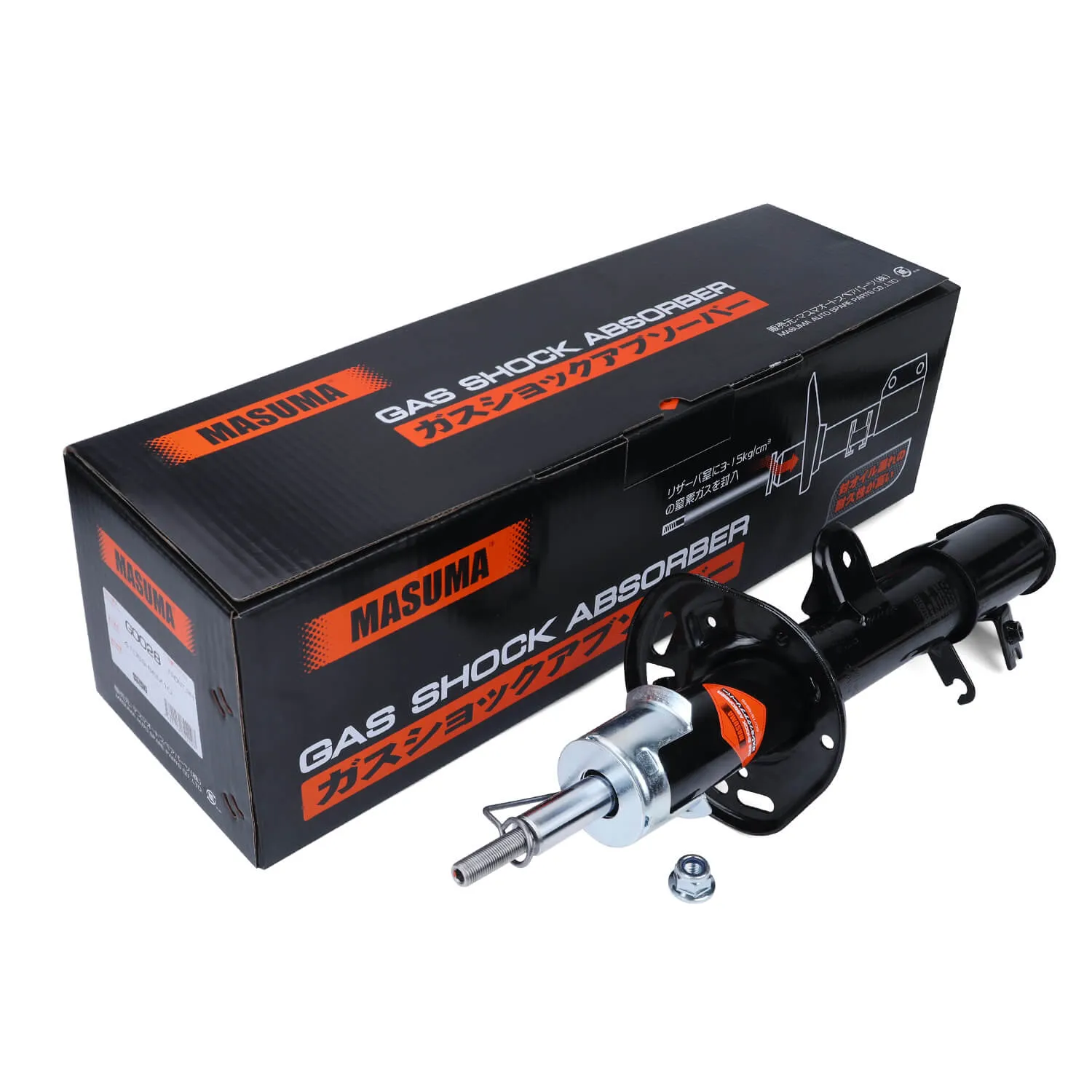
MASUMA gas shock absorber assembly and packaging box
01 MASUMA Shock Absorber Product Lines: Hydraulic, Twin-Tube & Mono-Tube
To meet diverse regional road conditions and market price tiers, MASUMA structures its passenger car shock absorber supply across three core technologies:
- Hydraulic Shock Absorbers ("N" Series): Built with all-weather damping fluid, multi-lip oil seals, and 3-stage rebound/compression valves. Ideal for standard urban commuting and cost-effective OE replacement.
- Twin-Tube Gas-Filled Shock Absorbers ("G", "P" & "T" Series): Charged with pressurized nitrogen (N2) gas to prevent oil aeration and damping fade on rough roads. The "G" and "T" Series feature Teflon-coated rod guide bushings and rebound cushions to minimize internal friction, while the "P" Series is reinforced with a sintered iron rod guide, sintered iron piston, seamless cylinder, and protective outer shell for heavy-duty durability.
- Mono-Tube Gas-Filled Shock Absorbers ("V" Series / GAS-A-JUST): Utilizes a floating dividing piston to separate high-pressure nitrogen gas from damping fluid inside a single seamless cylinder. Delivers superior heat dissipation and rapid damping response for demanding driving conditions.
| Product Line | MASUMA Series | Damping Medium | Key Structural Feature | Best Application |
|---|---|---|---|---|
| Hydraulic | "N" Series | Oil + Air | 3-stage valves, multi-lip seal | Everyday urban driving, value-tier replacement |
| Twin-Tube Gas | "G" / "T" Series | Oil + Pressurized N2 | Teflon-coated bushing, rebound cushion | All-around passenger cars, rough road stability |
| Twin-Tube Gas (Heavy-Duty) | "P" Series | Oil + Pressurized N2 | Sintered iron guide & piston, protective shell | High-load vehicles, harsh road environments |
| Mono-Tube Gas | "V" Series | Oil + High-Pressure N2 | Floating dividing piston, single seamless tube | Performance handling, rapid heat dissipation |
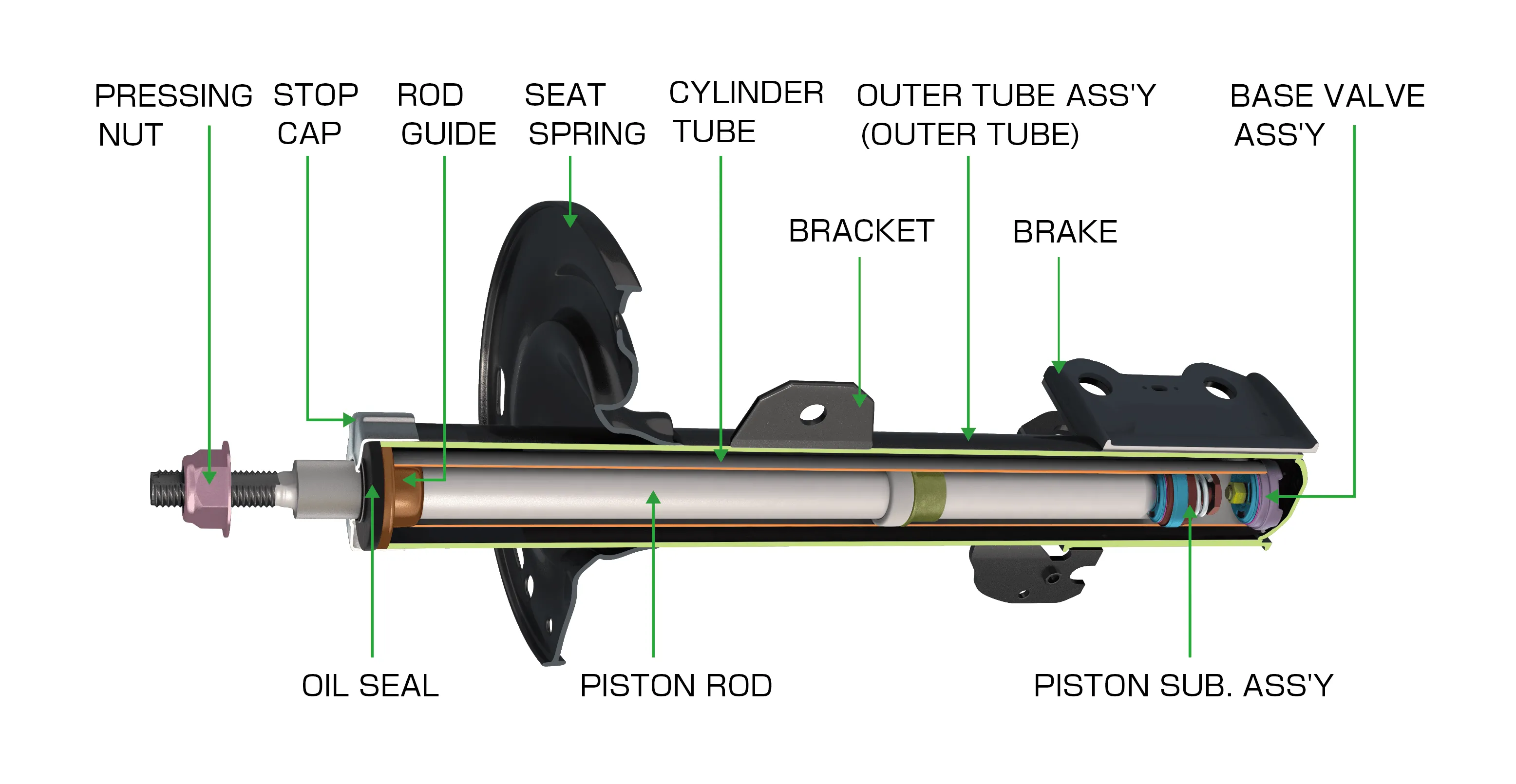
Shock absorber cross-section and internal component layout
02 Manufacturing Standards & Quality Control
For wholesale buyers, minimizing early oil leaks and fitment comebacks is critical. MASUMA enforces strict manufacturing benchmarks across every production batch:
TRIP Alloy Hard-Chromed Piston Rods
One-piece formed from specialized TRIP steel and finished with high-precision hard chrome plating to reduce seal friction, jamming, and noise.
Multi-Lip Seals & All-Weather Fluid
High-grade multi-lip oil seals paired with all-weather hydraulic fluid help prevent leakage across a wide range of operating temperatures.
Precision Welding & Anti-Corrosion Coating
Automated welding ensures brackets and spring seats match exact OE mounting geometry, while a high-grade surface paint finish protects the body against corrosion.
Damping Force Testing on Every Batch
Every batch undergoes force-velocity testing to verify that compression and rebound curves align with original equipment specifications.
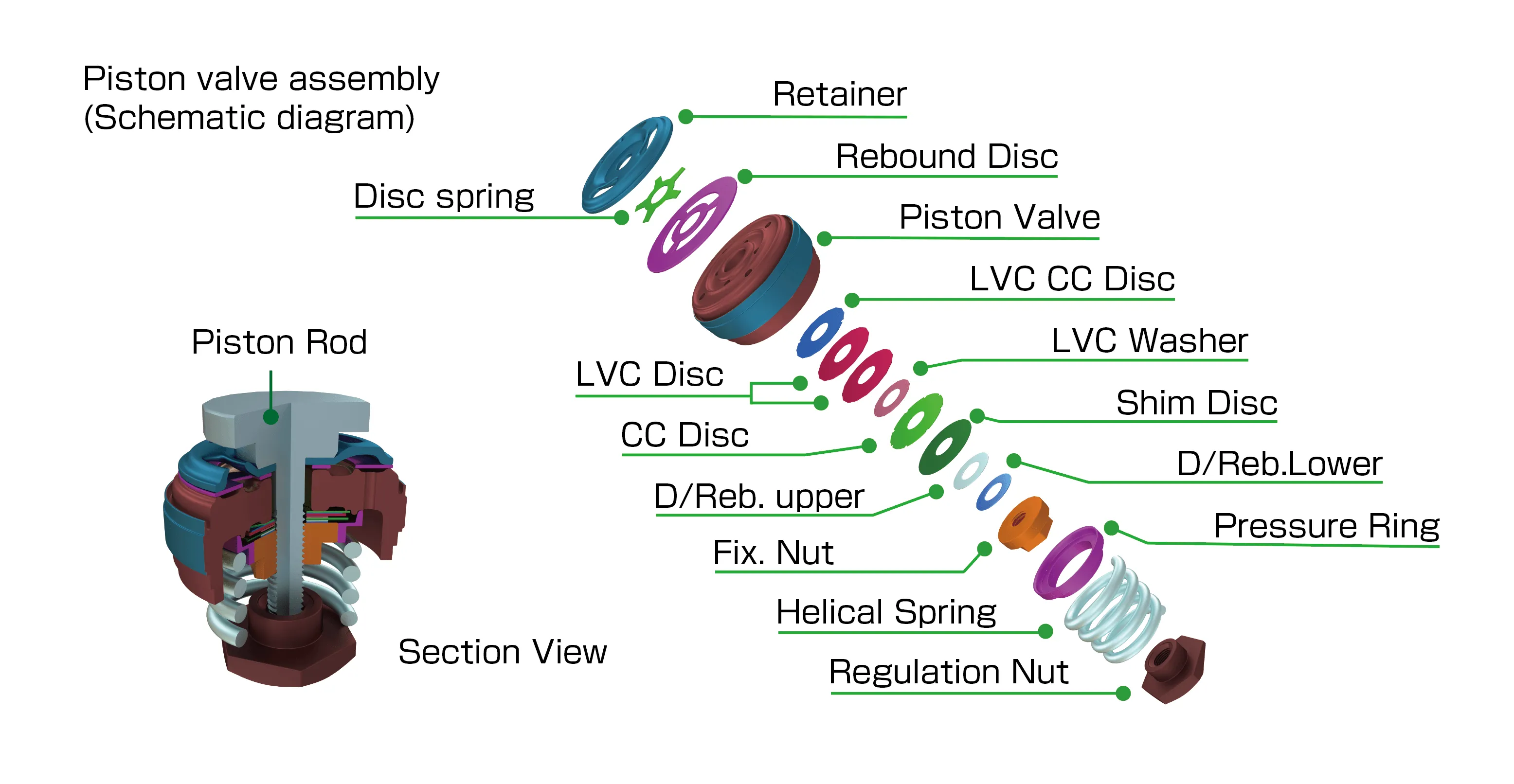
Piston valve assembly exploded schematic
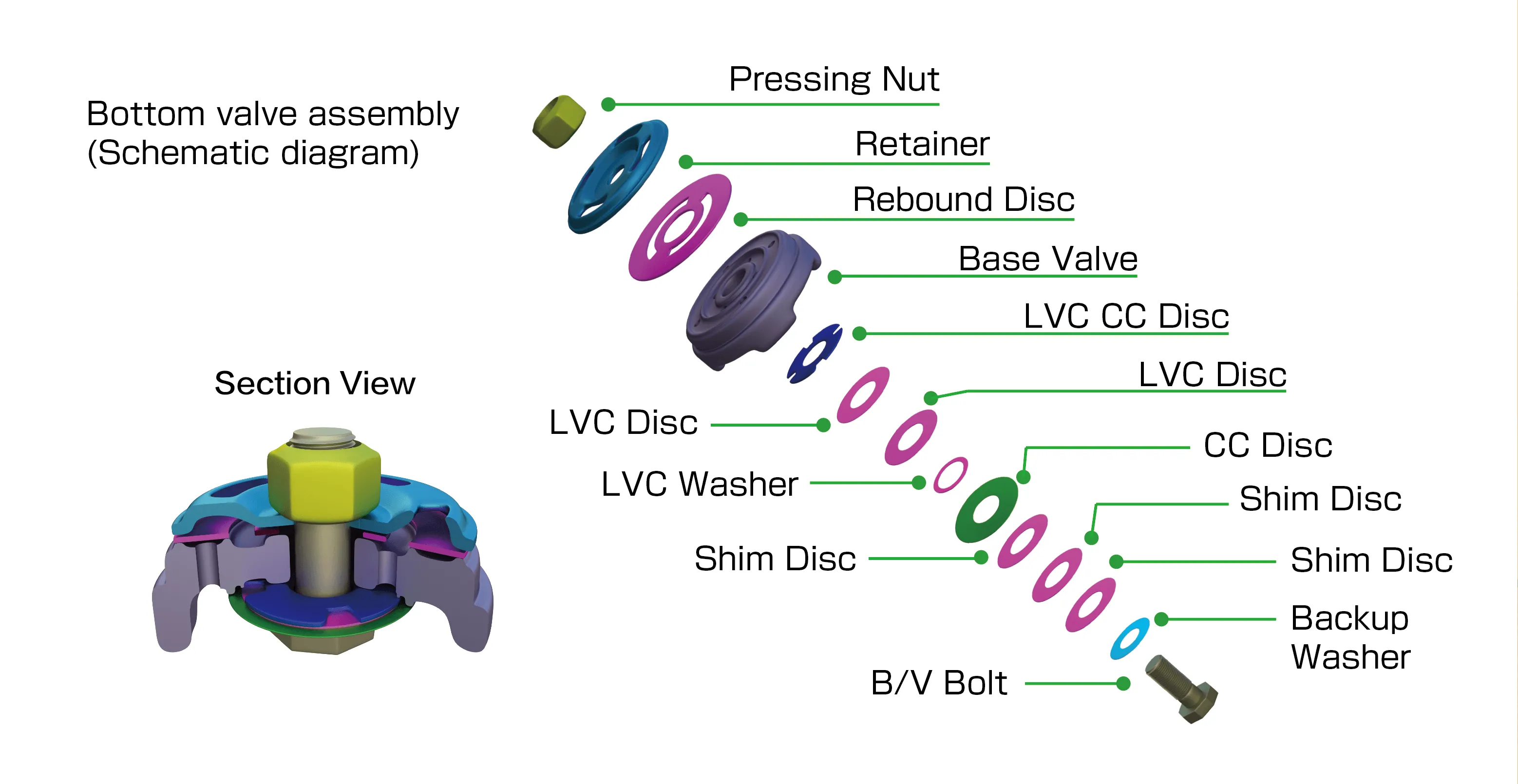
Bottom valve assembly exploded schematic
Video Overview: Everything You Need to Know About MASUMA Shock Absorber
03 Shock Absorber vs. Strut vs. Coil Spring
Understanding the functional boundaries of suspension components helps workshops and parts buyers select the exact replacement SKU:
| Component | Primary Function | Supports Vehicle Weight? | Key Maintenance Note |
|---|---|---|---|
| Shock Absorber | Controls spring oscillation via hydraulic damping | No | Replaced independently without compressing springs |
| Strut Assembly | Combines damping unit with structural suspension pivot | Yes | Affects steering geometry; requires alignment after replacement |
| Coil Spring | Absorbs road impact energy and maintains ride height | Yes | Works alongside dampers; sagging springs overload shocks |
04 Field Diagnostics & Replacement Guidelines
Worn shock absorbers compromise braking distance and tire life. Common failure symptoms include visible oil seepage on the cylinder body, excessive bouncing over speed bumps, nose-diving under braking, cupped tire wear, and chassis knocking noises.
| Symptom | Likely Cause | What to Check |
|---|---|---|
| Oil seepage on the cylinder body | Worn oil seal or a scored piston rod | Replace the unit; check the dust cover and rod surface |
| Excessive bouncing after bumps | Loss of damping force | Run the bounce test below; replace in pairs if it fails |
| Nose-diving under braking | Weak compression damping on the front axle | Inspect the front units first |
| Cupped or uneven tire wear | Tire losing consistent contact with the road | Check the shock absorbers before blaming alignment alone |
| Knocking noises over rough roads | Worn strut mount, rubber buffer, or internal wear | Inspect the mount, buffer, and dust cover together |
| Longer braking distance, more body roll | Reduced tire contact and poor weight-transfer control | Treat as a safety issue; inspect promptly |
Common Causes of Failure
- Seal Deterioration: Heat, age, and contaminated fluid gradually harden the oil seal until damping fluid starts to seep out.
- Piston Rod Damage: Once a dust cover tears, grit scores the piston rod surface, and every stroke then wears the seal further.
- Corrosion: A damaged paint finish lets moisture attack the cylinder body and rod, shortening service life.
- Worn Auxiliary Parts: A collapsed rubber buffer or worn strut mount passes extra impact into the damper instead of absorbing it.
- Overload and Rough Roads: Repeated heavy loads and severe impacts fatigue the valves and bushings long before their expected service life.
3-Step Quick Inspection
Bounce Test: Press down firmly on one corner of the vehicle and release. If the body rebounds more than 1 to 2 times before settling, damping resistance is worn out.
Low-Speed Braking Check: Brake abruptly at low speed on a safe road; excessive front-end pitch indicates weakened compression damping.
Shell Temperature Check: Drive roughly 10 km over uneven roads, park, and carefully touch the shock absorber housing. A working unit generates noticeable heat; a cold housing indicates internal valve failure.
Workshop Replacement Standards
- Check the Service Interval: Inspect shock absorbers regularly from around 50,000 km. Typical service life is about 80,000–100,000 km, but rough roads, heavy loads, and harsh climates can shorten it significantly — replace based on condition and the inspection results above, not on mileage alone.
- Always Replace in Pairs: Replace both left and right units on the same axle to maintain symmetrical damping and balanced braking.
- Inspect & Replace Auxiliary Parts: Worn dust covers allow grit to score new piston rods and ruin oil seals. Always check strut mounts, dust covers, and rubber buffers during installation.
- Perform a 4-Wheel Alignment After Strut Replacement: Mandatory after replacing structural struts to restore factory camber and toe angles. Replacing a standalone shock absorber on its own does not normally require an alignment.
05 Why Partner with MASUMA as Your Shock Absorbers Supplier
- Broad Passenger Car Coverage: Extensive SKU coverage across Japanese, European, American, and Korean passenger vehicles with accurate OE cross-referencing.
- One-Stop Chassis Supply: Source MASUMA shock absorbers alongside matching strut mounts, dust covers, rubber buffers, coil springs, control arms, and ball joints from a single supplier.
- Consistent Batch Quality & Export Support: Backed by damping force testing on every batch and reliable international logistics. Send your target OE list for matching and a wholesale quotation.
Partner with an experienced shock absorbers supplier.
Contact the MASUMA sales team today for full SKU catalogs, OE matching, and wholesale quotes →
 Next Article