









 Home
Home
 Share
Share


When driving over bumps, around sharp corners, or along smooth highways, your vehicle’s suspension system works endlessly to ensure a comfortable ride and stable handling. At the heart of this system is a small yet crucial component: the ball joint.
In this comprehensive guide, we will break down what ball joints do, where they are located, how to spot signs of wear, and why upgrading to MASUMA ball joints keeps your drive safe and smooth.
1. What Is a Ball Joint and How Does It Work?
The Role of Ball Joints in Your Car's Suspension
A ball joint is a critical pivot point in your vehicle's front suspension. It connects the steering knuckle (which holds the wheel) to the control arms (which connect to the frame).
Because your wheels must move up and down to absorb bumps while simultaneously pivoting left and right to steer, a rigid connection won't work. The ball joint provides the flexible multi-axis rotation required for precise vehicle control and maximum tire contact with the road.
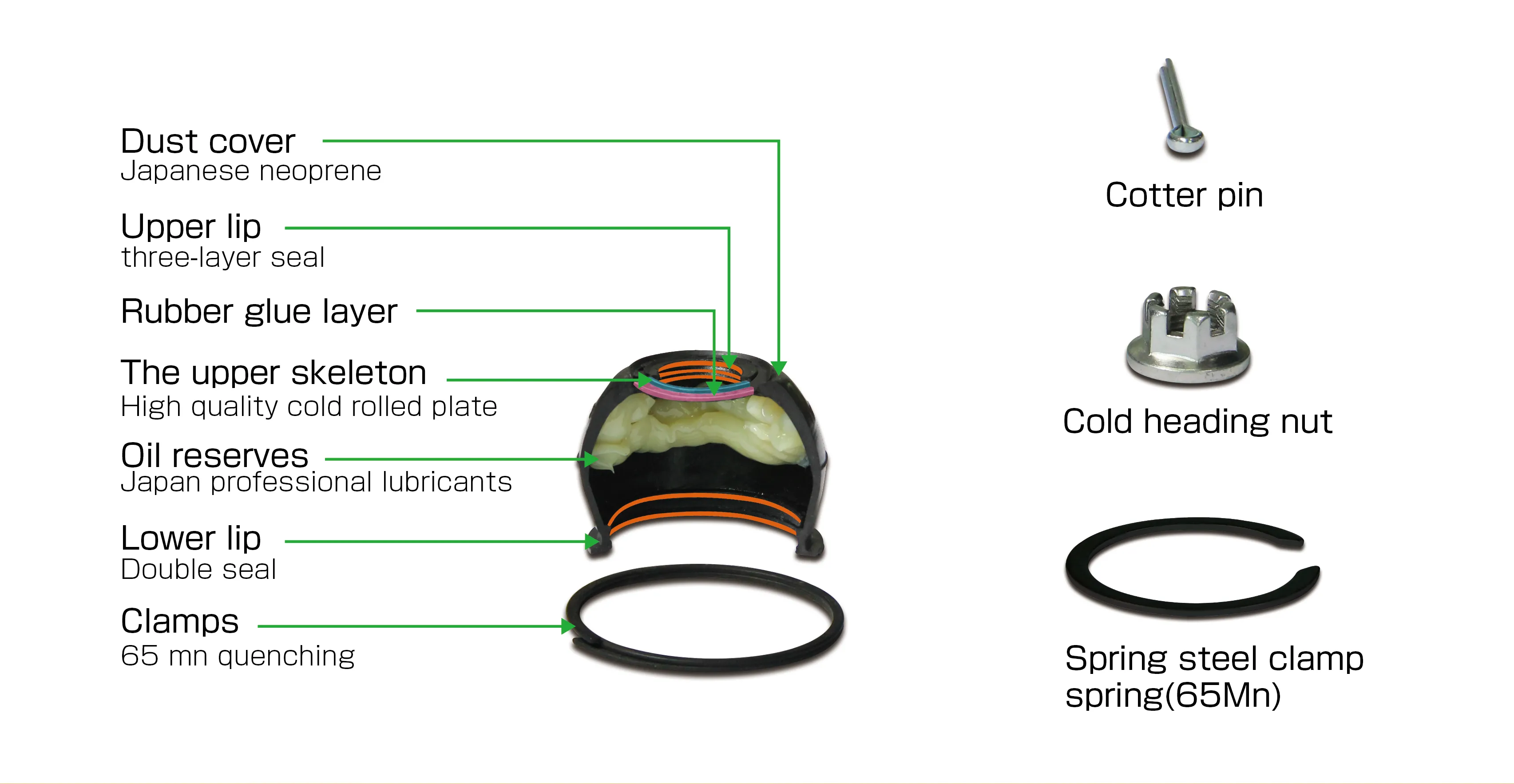
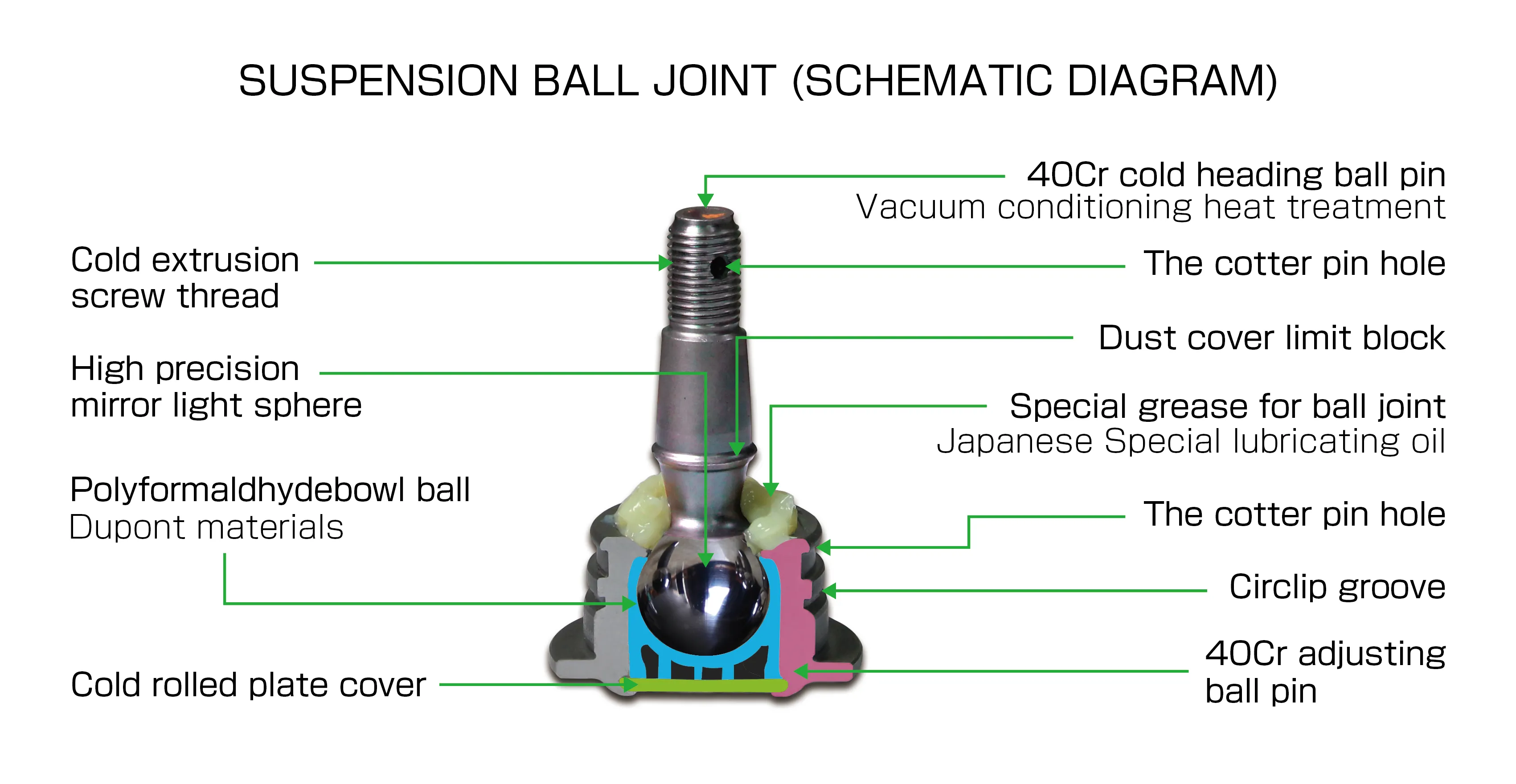
Ball Joint Diagram & Anatomy
2. Where Are Ball Joints Located on a Vehicle?
Ball joints are located at the front suspension assembly near each front wheel. You can spot them attached between the ends of the control arms and the steering knuckle.
Depending on your vehicle’s suspension setup, ball joints are positioned at either the top, the bottom, or both points of the steering knuckle to anchor it securely to the chassis while allowing fluid movement.
3. Types of Suspension Ball Joints
Not all ball joints carry out the exact same job. Vehicles use two main categories depending on where they are mounted and how loads are distributed.
Mounted on the upper control arm, these act as follower joints. They maintain suspension alignment and absorb lateral (turning) forces without carrying the weight of the vehicle.
Mounted on the lower control arm, these serve as the main pivot point. Depending on the suspension system, lower ball joints can be load-carrying (supporting vehicle weight in compression or tension) or a follower type.
Designed as maintenance-free units pre-filled with grease. However, if the rubber boot cracks, water and debris enter, rapidly leading to joint failure.
Feature a Zerk fitting that allows fresh grease to be added, flushing out contaminants and significantly extending the part's service life.
4. CV Joint vs. Ball Joint: What’s the Difference?
It’s common to confuse CV joints and ball joints, as both feature spherical pivoting mechanics near the wheel. However, they serve completely different systems:
- System: Part of the drivetrain (axle assembly).
- Primary Function: Transfers rotational power from the engine and transmission directly to the driven wheels.
- Key Movement: Allows the drive axle to flex and pivot while steering and traveling over bumps, without losing power transfer.
- System: Part of the steering and suspension system.
- Primary Function: Acts as a structural pivot point connecting the control arms to the steering knuckle.
- Key Movement: Allows the wheels to turn left/right for steering while moving up/down with suspension travel.
5. Symptoms of a Bad or Worn Ball Joint
Driving on worn-out ball joints is extremely dangerous. If a ball joint fails completely, the wheel can detach from the control arm, leading to a catastrophic loss of vehicle control. Watch out for these warning signs:
- Clunking or Squeaking Noises: A metallic clunking sound when driving over bumps or a sharp squeak when turning the steering wheel indicates worn bearings or lack of lubrication.
- Steering Wheel Pull or Vibration: Loose ball joints cause slop in the front end, leading to a loose or pulling steering wheel.
- Uneven Tire Wear: Excess play in the ball joint ruins wheel alignment, causing premature or uneven wear on the inner or outer edges of your tires.
6. Why Choose Premium MASUMA Ball Joints for Replacement?
Watch: Inside the Engineering of Masuma Ball Joints
Take a look at the 3D breakdown video below to see how Masuma precision engineering and heavy-duty materials deliver unmatched durability and safety.
When it comes to steering and suspension, precision and durability are non-negotiable. MASUMA ball joints are engineered to meet and exceed OE standards, providing long-lasting reliability under harsh driving conditions.
- High-Precision Chrome Steel Ball Studs: Premium alloy construction with heat treatment ensures exceptional tensile strength and wear resistance.
- Heavy-Duty Synthetic Dust Boots: Made from high-grade CR rubber resistant to extreme temperatures, ozone, and road chemicals to prevent boot rupture.
- Advanced Synthetic Grease: Pre-lubricated with high-performance synthetic grease for smooth, quiet, and friction-free operation.
- Exact OE-Match Fitment: Precision machining guarantees seamless installation and restores original factory steering feel and stability.
7. Frequently Asked Questions (FAQ)
Q1: Can I drive with a bad ball joint?
Q2: How long do car ball joints typically last?
Q3: Should I replace ball joints in pairs?
Q4: Do I need a wheel alignment after replacing a ball joint?
Q5: How can I check if my ball joints are bad?
- Visual Check: Look underneath the car for a cracked, torn, or leaking rubber dust boot. If grease is leaking or rust is visible, the joint is compromised.
- Pry Bar Test: Jack up the vehicle so the wheel is off the ground, then place a pry bar between the lower control arm and the steering knuckle. Pry upward; if you feel or see excess play/movement, the ball joint is worn out.
Q6: What causes a ball joint to fail?
- Boot Rupture & Contamination: Water, dirt, and road salt entering through a torn rubber boot, which washes away grease and corrodes the ball stud.
- Lack of Lubrication: Friction drying out the socket without proper grease protection.
- Road Impact & Heavy Loads: Frequent driving over potholes, rough terrain, or carrying overloaded cargo.
 Previous Article