




home Home > NEWS > Blog > Details
Diagnosing Wheel Hub Bearing Failure: Common Causes and Quality Solutions Introduction
2026-09-16
Share
Expert guide to identifying, analyzing, and preventing wheel hub bearing failures with professional engineering standards.

The wheel hub bearing plays a silent yet critical role in your vehicle. As the primary component supporting the wheel's rotation, it bears the vehicle's entire weight, along with acceleration forces, cornering lateral forces, and road impact. When a wheel hub bearing begins to fail, it compromises not just ride comfort, but vehicle safety.

In this guide, we will explore how to identify a bad wheel bearing, uncover the root causes behind premature failure, and examine how high-quality engineering and proper installation can provide a long-lasting solution.

Spotting the Symptoms – Is Your Wheel Bearing Bad?

Before fixing a problem, you need to diagnose it accurately. Common symptoms of a failing wheel hub bearing include:

The Tell-Tale Humming Noise: A distinct humming, growling, or rumbling noise that increases in pitch and volume as the vehicle speeds up.
Turn-Load Variations: If the noise gets louder when turning right, the load shifts to the left side, indicating a potential issue on the left (and vice versa).
Steering Wheel Vibrations: Excessive play in the bearing can translate into noticeable vibrations through the steering wheel.
Physical Play: When the vehicle is jacked up and the wheel is removed, wiggling the assembly should reveal no loose play or grinding resistance.

Root Causes of Bearing Failure (Failure Analysis)

Why do wheel bearings fail prematurely? Often, it comes down to installation errors or mechanical mismatches rather than just natural wear:
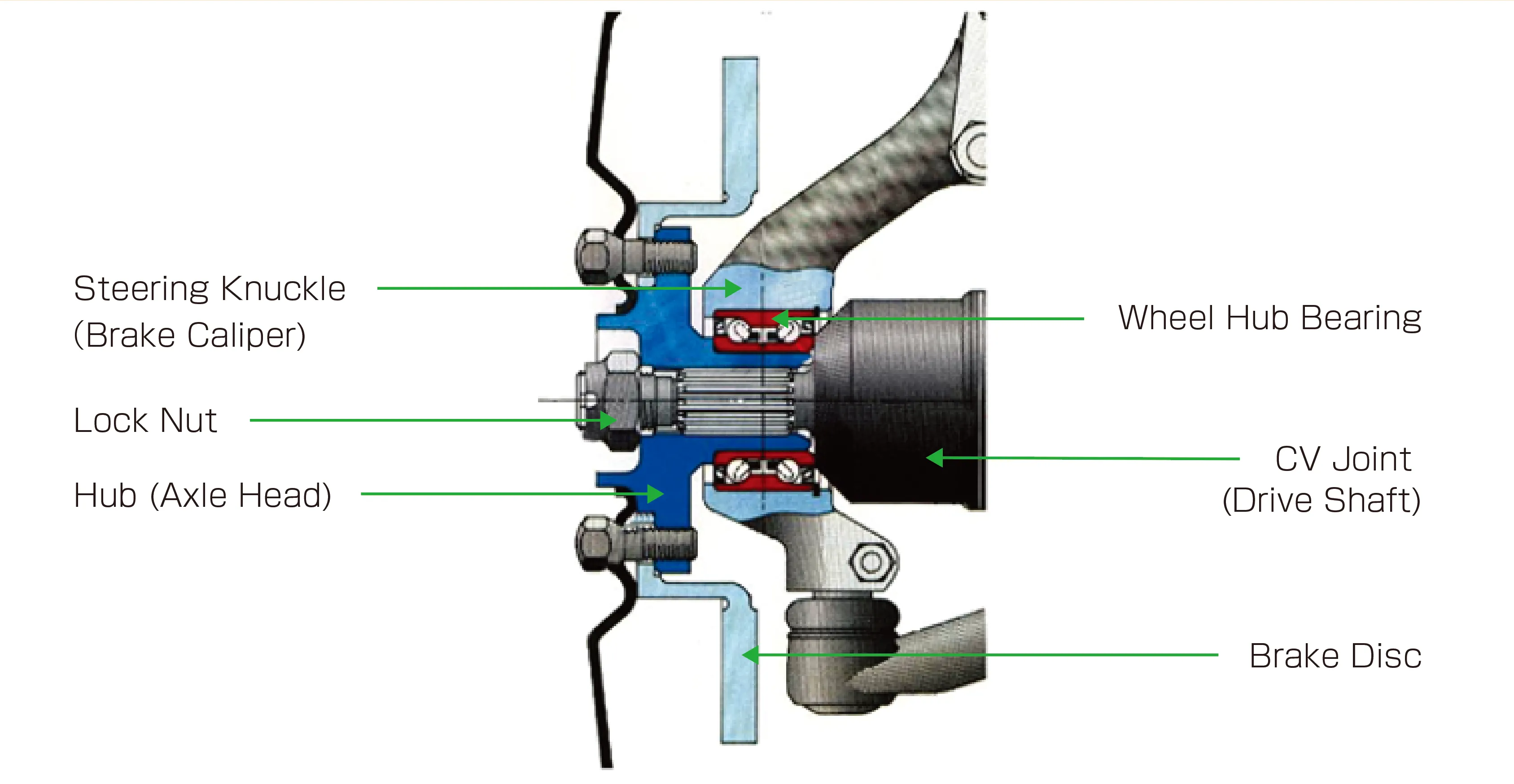
Wheel Hub Bearing Assembly Cross-section
Structural layout and assembly relationship of the wheel hub bearing and steering knuckle.
Incorrect Tightening Torque
If the axle lock nut is not tightened to the OEM's specified requirements, it leads to excessive play, abnormal noise, inner ring face wear, and raceway spalling.
Standard reference: M18: 190–220 Nm; M20/M22: 210–240 Nm; M24: 250–300 Nm.
Steering Knuckle or Axle Head Tolerance Issues
If the steering knuckle's inner bore or the axle head is out of specified tolerance, it causes uneven contact, localized rust, or scoring on the bearing rings.
Improper Installation Force
Applying incorrect pressing force directly through the balls or onto the inner ring during installation damages the precision-ground raceway surface.

Quality Solutions – Why MASUMA Bearings Stand Out

To prevent recurring failures, choosing a premium replacement part is essential. MASUMA wheel hub bearings are engineered to surpass standard expectations through rigorous material selection and manufacturing:
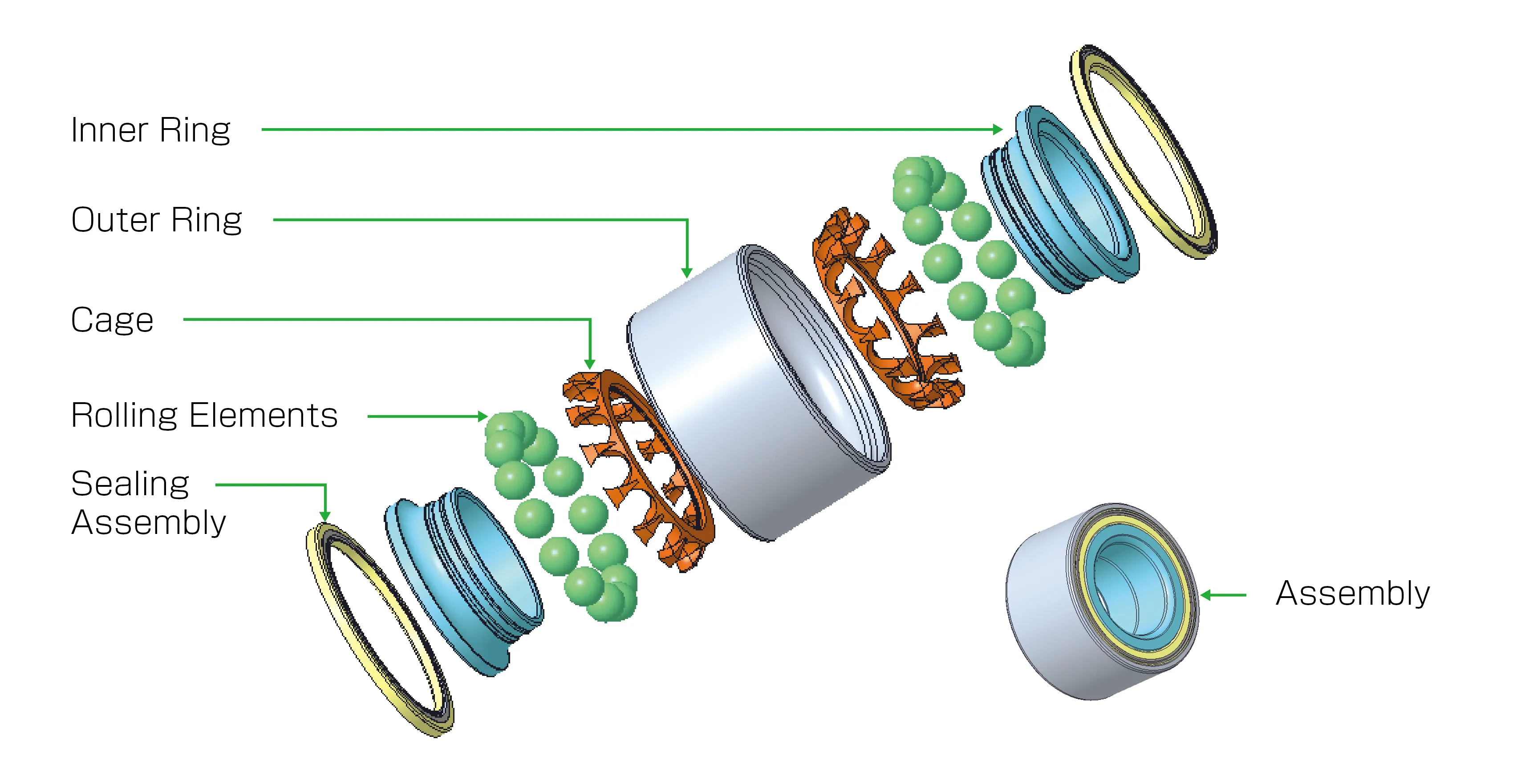
MASUMA Bearing Exploded View
Exploded view of MASUMA wheel hub bearing components.
Superior Raw Materials: Inner and outer rings utilize steel that surpasses standard specifications in chemical composition, non-metallic inclusions, and carbide homogeneity.
Advanced Forging Technology: Forged using electric heating, MASUMA rings offer a significantly longer service life than traditional tube-material processes.
High-Precision Cage: Manufactured from Germany's "BASF" reinforced nylon for exceptional impact toughness and aging resistance.
High-Precision Steel Balls: G10 grade with a surface roughness of <0.02µm, ensuring smooth, low-friction rotation.
Long-Lasting Lubrication & Sealing: Packed with premium greases from Shell, Kyodo Yushi, or Chevron, and protected by an optimized 2RZ combined sealing structure made of high-quality Japanese rubber (NJ230) to block out water and dust effectively.

Frequently Asked Questions (FAQ)

Q1: How can I tell if my wheel bearing is bad?

Start by listening for a continuous humming, growling, or rumbling noise that gets louder as you speed up. You may also feel vibrations through the steering wheel. To confirm, jack up the car, remove the wheel, and check if there is any looseness (play) or rough grinding when rotating the hub.

Q2: What happens if I drive with a bad wheel bearing?

Driving with a failing bearing is dangerous. It can cause uneven tire wear, severe steering vibration, friction heat that damages adjacent components, and in worst-case scenarios, complete wheel separation while driving.

Q3: What are the main causes of premature wheel bearing failure?

The most common causes include failing to tighten the axle lock nut to the correct OEM torque specification, steering knuckle or axle head tolerances being out of range, and improper installation force (such as pressing against the inner ring).

Q4: How should I properly install a new wheel hub bearing?

Always clean the steering knuckle bore before installation. When pressing the bearing into the knuckle, never apply force directly to the inner ring; conversely, ensure even force is applied to the inner ring when pressing the hub in. Always use a calibrated torque wrench to tighten all bolts and lock nuts to exact OEM specifications.

share
Share title
MASUMA Homepage
Share link
http://www.masuma.com/home
Share title
MASUMA Homepage
Share content
Masuma was founded in 1998. Masuma auto spare parts co., ltd has its headquarters in tokyo, japan.it is an international auto parts enterprise integrating r&d andmanufacturing with independent intellectual property rights.
ffc88dccede2b28ec08b9e84c010de0d2422e3378d16d257c3fbc2773c0746e8
959a80928835620f9e5209f3fc72906e89acee1d86a3fd30c3bfa3c11e402410
17d16ec239902becdb38e76a6c50fca4ff7e3ac2a79587a52134012258884ef8
2121top