









 Home
Home
 Share
Share


Introduction
An oxygen sensor (also known as an o2 sensor) is a critical electronic device located in a vehicle's exhaust system that measures the proportion of oxygen in the exhaust gases. By constantly monitoring oxygen levels, the sensor provides real-time feedback to the engine management system to adjust the air-fuel ratio for optimal combustion, fuel efficiency, and lower emissions.
Whether you are a professional mechanic or an automotive parts distributor, understanding what an oxygen sensor does and how to diagnose a failing unit is essential for maintaining vehicle performance and passing emissions inspections.
What is an Oxygen Sensor and What Does It Do?
The primary oxygen sensor function is to continuously balance the air-fuel mixture inside the combustion engine. For gasoline engines to run efficiently, the ideal air-fuel ratio is approximately 14.7:1 (known as the stoichiometric ratio).
• Rich Mixture (Too Much Fuel): When there is insufficient oxygen in the exhaust, the ECU reduces fuel injection.
• Lean Mixture (Too Much Air): When there is excess oxygen in the exhaust, the ECU increases fuel injection.
In many international markets and European technical manuals, this component is also referred to as a lambda sensor (or lambda probe) because the Greek letter Lambda (λ) represents the stoichiometric air-fuel balance.
Air Fuel Ratio Sensor vs Oxygen Sensor
While discussing modern vehicle oxygen sensors, it is important to distinguish between conventional zirconia oxygen sensors and wideband air fuel ratio sensors (AFR sensors). Standard O2 sensors generate a simple voltage switch (0.1V to 0.9V) when the mixture fluctuates, whereas AFR sensors provide a continuous, proportional current measurement, allowing for much finer engine fuel trimming.
How Does an Oxygen Sensor Work?
If you have ever wondered how oxygen sensors work, the key lies inside the sensor tip: a specialized ceramic element (zirconia or titania) coated with a thin layer of platinum.
As shown in the internal structure diagrams below, the sensor relies on a zirconium dioxide element paired with an integrated heater, platinum electrodes, and protective casing to measure oxygen differentials accurately.
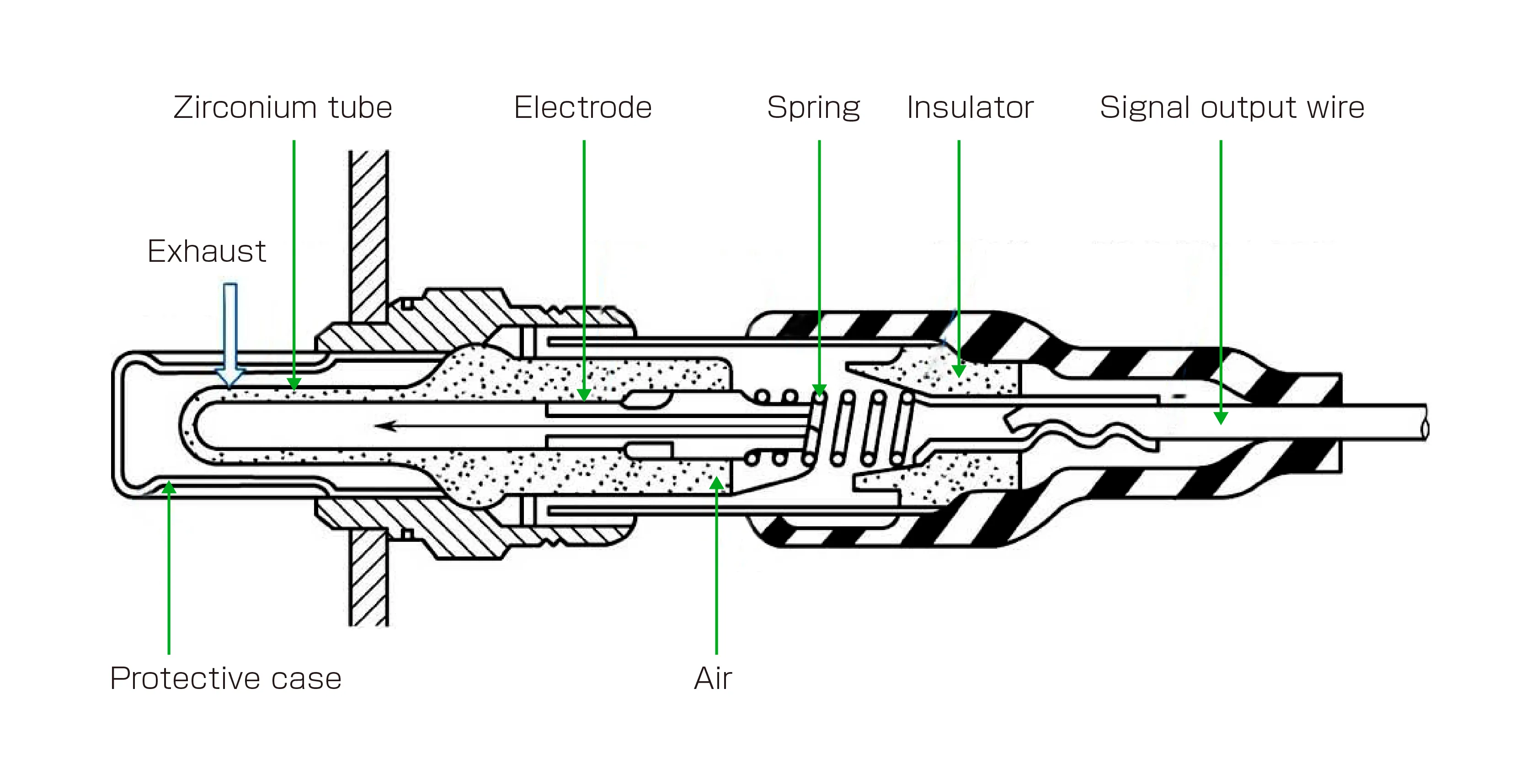
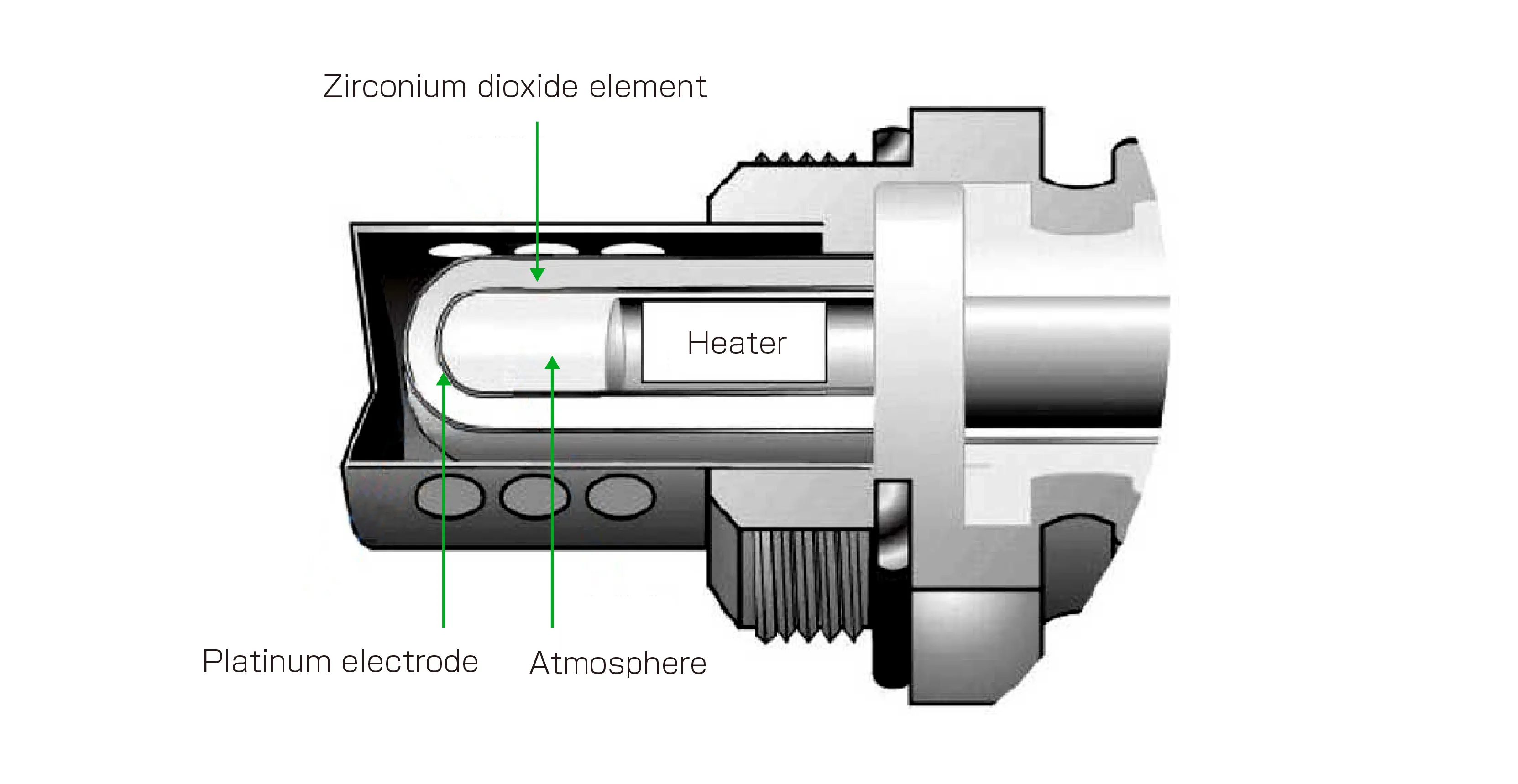
When heated to operating temperatures above 600°F (315°C), the oxygen ions migrate across the ceramic element, creating a small electrical voltage based on the difference between the ambient oxygen outside and the exhaust oxygen inside the exhaust pipe.
Most modern engines utilize a heated oxygen sensor (HO2S sensor). These sensors contain an internal resistance heating element that allows them to reach operating temperature in seconds, drastically reducing cold-start tailpipe emissions.
Where are Oxygen Sensors Located
Upstream vs. Downstream Oxygen Sensors
Knowing the precise location of oxygen sensors helps when performing diagnostics or replacing a faulty unit.
| Attribute | Upstream Oxygen Sensor (Sensor 1) | Downstream Oxygen Sensor (Sensor 2) |
|---|---|---|
| Position | Before catalytic converter (Exhaust Manifold) | After or on the catalytic converter |
| Primary Function | Measures raw exhaust to adjust air-fuel mixture | Monitors catalytic converter efficiency |
| Driveability Impact | High (Direct impact on fuel economy) | Low (Primarily for emissions diagnostics) |
Symptoms of a Failing Oxygen Sensor
Is an oxygen sensor important? Absolutely. A degraded or contaminated exhaust oxygen sensor can compromise catalytic converter health and lead to severe engine performance issues. Watch out for these warning signs:
Check Engine Light (MIL): The ECU will set a specific diagnostic trouble o2 sensor code (such as P0130 through P0167) when signal voltage limits are breached.
Poor Fuel Economy: A sluggish sensor often causes the engine to run excessively rich, burning far more gasoline than necessary.
Rough Engine Idling & Stumbling: Misfires or erratic RPM fluctuations at stoplights.
Failed Emission Test: Excess hydrocarbons and carbon monoxide emissions from the exhaust.
How to Read O2 Sensor Live Data
Technicians can verify sensor health using an OBD2 diagnostic scanner to view real-time live data graphs. A healthy upstream o2 sensor should rapidly switch between 0.1V and 0.9V at 2,000 RPM. A downstream o2 sensor should maintain a relatively steady voltage around 0.45V, indicating that the catalytic converter is storing oxygen effectively.
Are All Oxygen Sensors the Same? Choosing the Right Replacement
When selecting a new o2 sensor, precision matters. Cheap universal sensors often require cutting and wire splicing, which can introduce resistance errors into delicate millivolt signals.
Engineered with advanced ceramic technology and premium plate chips, MASUMA Oxygen Sensors outperform traditional finger-type designs with faster warm-up times and lower cold-start tailpipe emissions. Featuring multi-layer sensing elements and an integrated heater, MASUMA delivers precision air-fuel ratio control, immediate plug-and-play responsiveness, and long-term reliability in high-heat environments.
Experience the engineering quality up close: Watch our brief 3D showreel below to explore the precision construction, OE-style connectors, and high-grade materials of MASUMA oxygen sensors.

Advanced Ceramic Technology
Advanced planar chip tech achieves rapid warm-up, precise air-fuel ratio control, and lower emissions.

Long-Lasting Precision
Integrated multi-layer heating elements ensure consistent ECU signal feedback and maximum service life.

Find Your Oxygen Sensor
Partner with MASUMA today for OEM catalogs and wholesale inquiries.
Frequently Asked Questions (FAQs)
Q1: What OBD2 diagnostic trouble codes usually indicate a faulty oxygen sensor?
A: Common failure codes include P0130 to P0167, which cover circuit malfunctions, slow response times, and heater circuit faults in both upstream and downstream sensors. A scan tool can verify whether signal voltages are switching properly.
Q2: Are upstream and downstream oxygen sensors interchangeable?
A: No. Although they may look similar, upstream sensors (Sensor 1) are often wideband AFR sensors designed to adjust fuel delivery, while downstream sensors (Sensor 2) monitor catalyst efficiency. Using the wrong type or plug configuration will cause engine error codes and poor performance.
Q3: What factors affect oxygen sensor service life?
A: Oxygen sensor lifespan is affected by fuel quality, engine condition, exhaust temperature, and driving environment. Contaminants from oil, coolant, or poor combustion can damage the sensing element, while excessive heat and exhaust leaks may reduce sensor accuracy. Regular vehicle maintenance and using high-quality replacement sensors can help extend service life.
 Previous Article