





 English
 Home
Home
 Share
Share


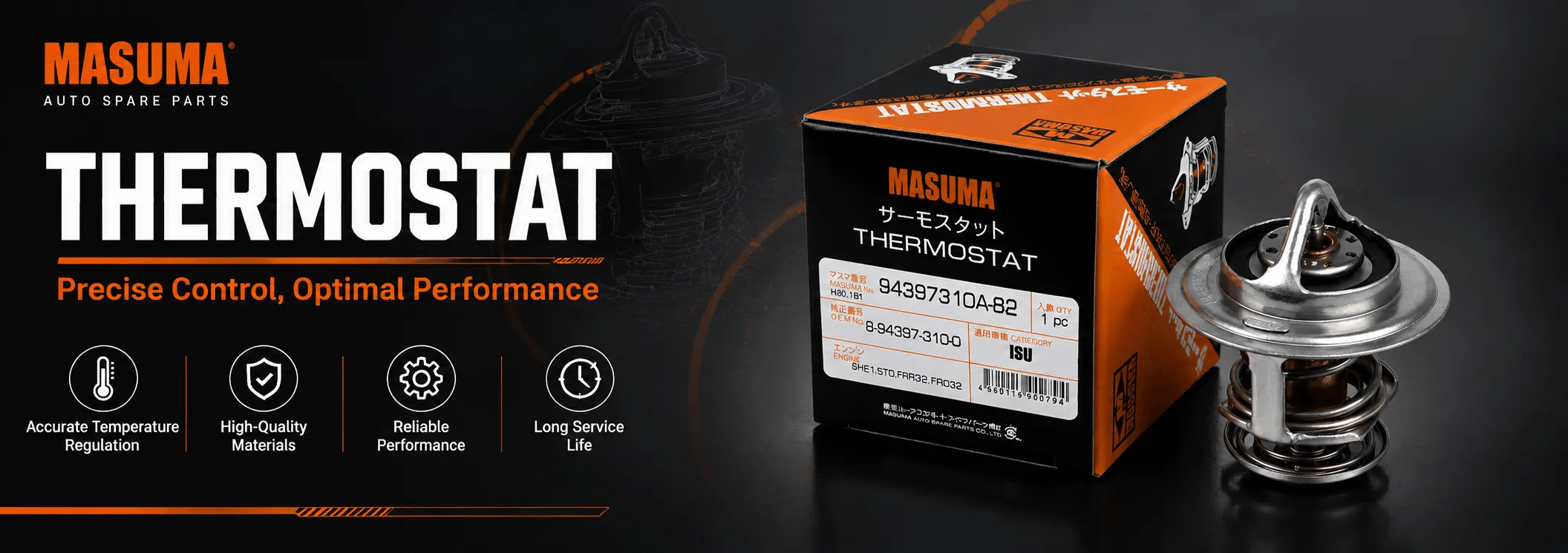
In a vehicle's complex cooling system, there is a small yet vital component that determines the life or death of the engine: the automotive thermostat. Many car owners overlook its existence until the engine suddenly overheats and boils over. As the "chief commander" of engine coolant circulation, what exactly does a car thermostat do? And how does it protect the engine? MASUMA reveals everything you need to know in this ultimate guide.
1. What is an Automotive Thermostat? Its Core Function
Simply put, an automotive thermostat is an automatic temperature control device. It typically contains a temperature-sensitive component that automatically turns the flow of coolant on and off by means of expansion or contraction based on the real-time temperature of the coolant.
Its core function is to automatically adjust the coolant flow rate into the radiator, changing the circulation range of the coolant to regulate the cooling capacity of the entire system, ensuring the engine always operates within its ideal temperature range.
To achieve the most efficient air purging and temperature control, most vehicle thermostats are arranged in the cylinder head outlet pipe. This design is simple in construction and makes it easy to drain air bubbles from the cooling system.
2. How Does a Wax Thermostat Work? The Secret of Small and Large Circulation
The thermostats used in modern engines are primarily wax thermostats. The core temperature control mechanism relies entirely on the principle of thermal expansion and contraction of the internal refined paraffin wax. During engine operation, the thermostat directs the coolant to switch between two modes:
A. Fast Warm-Up: "Small Circulation" under Cold Start
When the engine undergoes a cold start or the coolant temperature falls below the specified value, the refined paraffin wax inside the thermostat remains solid. At this point, under the action of the spring, the thermostat valve is closed, sealing the passage between the engine and the radiator.
- Coolant Route: Engine block → Water pump → Back to the engine.
- Purpose: It prevents the coolant from flowing to the radiator to dissipate heat, allowing the engine to warm up quickly within minutes and reducing cold-start wear.
B. High-Efficiency Cooling: "Large Circulation" under Hot Engine
When the coolant temperature reaches the specified value, the paraffin wax inside starts to melt and gradually turns into liquid; as the physical state changes, its volume increases and presses the internal rubber tube to make it shrink.
- Mechanical Linkage: While the rubber tube shrinks, it acts as an upward thrust to the push rod. The push rod then exerts a downward counter-thrust to the valve, overcoming spring resistance to open it.
- Coolant Route: Engine → Open thermostat valve → Radiator → Water pump → Back to the engine.
- Anti-Clogging Detail: To prevent ventilation hole blockage from affecting circulation, some high-spec thermostats feature a pendulum design.
3. Hardcore Materials and 7 Strict Tests of MASUMA Thermostats
Thermostat quality varies greatly in the aftermarket, and low-quality ones are highly prone to getting stuck. As a leading global automotive parts supplier, MASUMA sets industry standards equal to or exceeding OEM requirements in material selection and craftsmanship:
- The Gland: Made of high-grade H62/H65 brass. It features excellent mechanical properties, high strength, and superb plasticity under hot and cold conditions. It easily withstands severe thermal pressure fluctuations and offers superior corrosion resistance.
- The Wax Pellets: Made of premium refined paraffin wax (molecular formula $C_nH_{2n+2}$, where $n=20\sim40$). Key Process: Specially mixed with high-thermal-conductivity copper powder to multiply temperature sensitivity, achieving millisecond-level opening and closing responses.
- The Seal: Utilizes premium natural rubber imported from Thailand. It is highly resistant to aging, oil, and corrosion, ensuring excellent sealing performance under both extreme low and high temperatures.
- Structure and Springs: 430 stainless steel is used for the push rod, valve base, valve, bracket, sub-valve, and gasket. 304 stainless steel is used for the sub-spring. This all-stainless-steel protection offers outstanding anti-oxidation and corrosion resistance, ensuring it never rusts or jams even when submerged in coolant long-term.
The 7 Rigorous Testing Introductions
Every single MASUMA thermostat must completely pass the following 7 rigorous laboratory testing protocols to guarantee 100% reliability before delivery:
1. Temperature testing
2. Vibration testing
3. Environmental testing
4. Performance testing
5. Durability testing
6. Spectral analysis
7. Cleanliness testing
Many car owners only look at the price when buying replacement parts, overlooking the massive difference in wear and corrosion resistance among various metal and rubber materials. Want to know why premium materials determine replacement parts' longevity? Please refer to: [How Strict Is the Material Selection for a Premium Car Thermostat?], where we deeply break down the hardcore parameters of high-spec metal craftsmanship.
4. Car Thermostat Failure Symptoms (Infrared Thermometer Diagnosis)
An automotive thermostat is a standard wear item. Generally speaking, the safe life of a wax thermostat is 50,000 km of driving mileage, meaning it should be replaced regularly according to its lifespan.
Many people tend to wait until the engine completely boils over before visiting a repair shop. However, this often causes fatal damage like blown head gaskets or warped cylinder blocks, leading to repair bills worth thousands of dollars. To avoid major engine overhauls, is it time to replace your thermostat? Please refer to: [What Is the Safe Lifespan of a Car Thermostat & Why Preventative Replacement Matters?], where we break down the economics of routine maintenance versus engine rebuilds.
Generally, the coolant temperature should reach a normal operating temperature of 85°C to 105°C about five minutes after a cold start. If the temperature gauge fails to rise for a long time, or shoots straight up past 110°C, you should suspect a faulty thermostat.
When a failure is suspected, technicians or car owners can perform a non-invasive, precise diagnosis using an infrared thermometer:
- Scenario A (Coolant temperature over 110°C / Stuck Closed): Stop the engine, open the hood, and use the infrared thermometer to measure the radiator's upper hose, then the lower hose. Both hoses should be very hot. If there is a large temperature difference between the upper and lower hoses, it is determined that the thermostat is faulty (stuck closed, blocking large circulation).
- Scenario B (Fails to reach normal temp for a long time / Stuck Open): Stop and let the engine temperature drop to the same temperature as the air temperature, and then start the engine. Watch the dashboard temperature rise to about 70°C (not to more than 80°C), then stop the engine and open the hood. Use the infrared thermometer to measure the radiator's upper and lower hoses; if there is no temperature difference, it is determined to be a thermostat failure (stuck open, causing premature large circulation).
- Housing Precision Test: Aim the infrared thermometer directly near the thermostat housing, testing the thermostat inlet and outlet temperature changes to determine if it opens. When the engine starts, the inlet temperature will increase while the thermostat remains off/closed. When the water temperature gauge reaches 70°C, test the temperature of the water outlet; it should suddenly increase, and the dashboard gauge should be above 80°C, indicating that the thermostat is open and working normally. If the temperature does not change, it indicates the thermostat is not working well and needs to be replaced.
Summary & Conclusion
Although the automotive thermostat is a small and simple component, it plays the vital role of a "gatekeeper" within the vehicle's cooling architecture. From the thermal expansion mechanics of refined paraffin wax to the strict metallurgy of brass and stainless steel, every engineering detail directly impacts engine health and operational longevity. Monitoring temperature behavior and conducting preventative replacements at safe mileage benchmarks remain the smartest choices for vehicle maintenance.
As a professional global automotive parts provider, MASUMA is fully dedicated to manufacturing premium-quality replacement parts that meet or exceed OEM specifications. If you are searching for highly durable thermostats or other vital cooling components for your vehicle fleet or market demand, feel free to browse our official catalog or connect directly with our B2B team for technical and sourcing solutions.
 Next Article