




home Home > NEWS > Blog > Details
Brake Fluid Replacement Guide: Symptoms, Change Intervals & B2B Supply Solutions
2026-09-04
Share

Brake fluid is one of the most critical yet often overlooked components in a vehicle's hydraulic braking system. While brake pads and brake discs usually receive the most attention during maintenance, brake fluid is responsible for transmitting braking force throughout the entire system and ensuring safe vehicle operation.

Drivers may experience a spongy brake pedal, delayed braking response, or increased stopping distance. While these symptoms can be related to worn brake pads or brake discs, degraded brake fluid is also a common and often overlooked cause. This article explains how brake fluid works, the risks associated with fluid degradation, recommended replacement intervals, and reliable brake fluid solutions for automotive distributors, importers, and aftermarket professionals.

1. How Brake Fluid Works and Its Key Performance Requirements

Brake fluid serves as the hydraulic medium inside the master cylinder, brake lines, and wheel cylinders or calipers. When the driver presses the brake pedal, force is transferred through the master cylinder piston. Because liquids are essentially incompressible, hydraulic pressure is transmitted instantly and evenly throughout the braking system, allowing brake pads or brake shoes to apply friction and slow the vehicle.
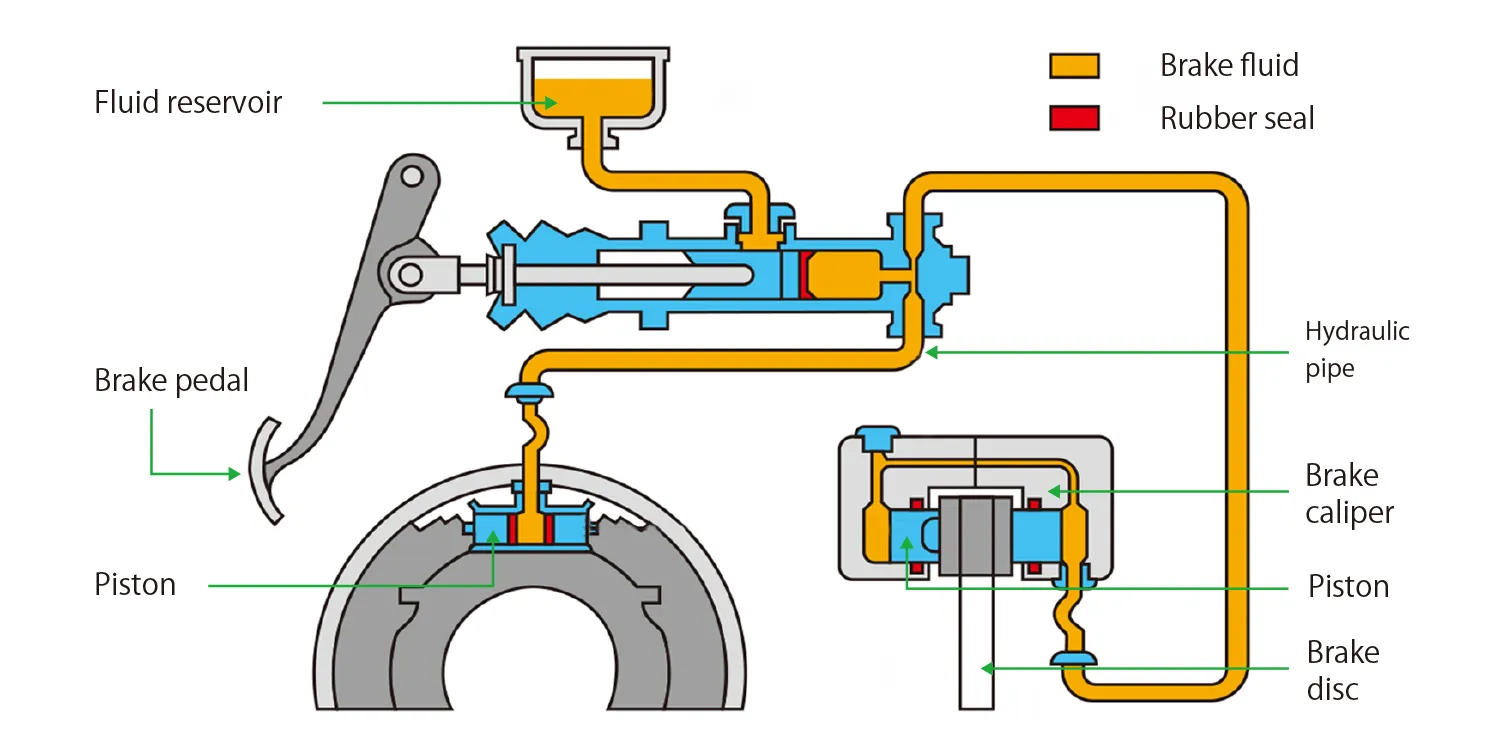
Typical Hydraulic Braking System Layout

To ensure reliable braking performance under various driving conditions, high-quality brake fluid must possess several critical characteristics:

High Dry and Wet Boiling Points During repeated braking, mountain driving, towing, or other high-load conditions, brake system temperatures can rise significantly. Brake fluid must maintain a high boiling point to prevent vapor formation, which can lead to brake fade or vapor lock.
Excellent Low-Temperature Fluidity Modern vehicles rely on advanced electronic braking systems such as ABS (Anti-lock Braking System), ESP (Electronic Stability Program), and TCS (Traction Control System). Brake fluid must remain fluid at low temperatures to ensure rapid and precise system response.
Corrosion and Oxidation Resistance Brake systems contain steel, aluminum, copper alloys, and various rubber seals. Quality brake fluid should protect these materials from corrosion, oxidation, and premature deterioration throughout its service life.
Lubrication Performance Brake fluid also lubricates internal hydraulic components, reducing wear on pistons, seals, and other moving parts while extending overall system durability.

2. Why Regular Brake Fluid Replacement Is Important

One of the most important characteristics of brake fluid is its hygroscopic nature. Over time, brake fluid absorbs moisture from the surrounding environment through hoses, seals, and reservoir vents. As moisture content increases, several safety and performance issues can develop.

Reduced Boiling Point and Vapor Lock Risk Water contamination significantly lowers the boiling point of brake fluid. Under heavy braking conditions, absorbed moisture may vaporize and form gas bubbles within the hydraulic system. Unlike liquid, gas is compressible, resulting in a soft or spongy brake pedal, reduced braking efficiency, and in extreme situations, partial or complete brake failure.
Internal Corrosion and Component Damage Moisture-contaminated brake fluid can accelerate corrosion inside brake lines, master cylinders, wheel cylinders, and calipers. Over time, this may lead to sticking calipers, damaged seals, fluid leakage, and costly repairs.
RECOMMENDATION Recommended Brake Fluid Change Interval Replacement intervals vary among vehicle manufacturers, but industry practice generally recommends replacing brake fluid every 2 to 3 years or approximately 30,000 miles (50,000 km). Vehicles operating in humid climates, mountainous regions, or heavy-duty conditions should have brake fluid moisture levels checked regularly. Many service professionals recommend replacement when moisture content exceeds 3%.
Important: Use Opened Brake Fluid Promptly Once opened, brake fluid begins absorbing moisture from the air. Opened containers should be tightly sealed and used as soon as possible. Long-term storage after opening is not recommended because moisture contamination may reduce performance.
Important: Avoid Mixing Different Specifications Mixing brake fluids with different specifications or chemical base formulations is not recommended. Always follow the vehicle manufacturer's requirements regarding brake fluid type and performance standards.

3. MASUMA Brake Fluid Solutions for the Global Automotive Aftermarket

As a global automotive parts manufacturer and supply chain partner, MASUMA provides high-quality brake fluid solutions designed to meet the performance requirements of modern braking systems.

  • Compliance with International Standards: Complies with DOT 3, DOT 4, DOT 5.1, and Japanese BF Standards. Suitable for a wide range of passenger vehicles across global markets.
  • Advanced Synthetic Formulation: Formulated using high-quality synthetic base components and carefully balanced additive packages that enhance oxidation resistance, corrosion protection, rubber compatibility, and thermal stability.
  • Reliable Protection for Modern Braking Systems: Provides stable hydraulic pressure transmission while helping protect metal components and rubber seals throughout the braking system's service life.

4. B2B Supply Advantages for Distributors and Importers

MASUMA supports automotive aftermarket businesses worldwide, including distributors, importers, wholesalers, repair chains, and fleet operators.

  • OEM-Level Quality Standards: Strict quality control procedures ensure consistent product performance across various operating temperatures and environmental conditions.
  • Comprehensive Product Range: Multiple specifications and packaging options are available to accommodate different market requirements and distribution channels.
  • Stable Global Supply Chain: MASUMA provides reliable manufacturing capacity, international logistics support, and professional B2B services to help partners maintain stable inventory and business growth.

5. Frequently Asked Questions

Q1: Should brake fluid be replaced if it becomes dark or cloudy?
A: Yes. Fresh brake fluid is typically clear or light yellow. Dark, cloudy, or contaminated fluid may indicate oxidation, moisture absorption, or internal component wear. Replacement is recommended to maintain braking system reliability.
Q2: Why does the brake pedal still feel soft after brake fluid replacement?
A: Air may remain trapped inside the hydraulic system after the brake fluid service. Because air is compressible, the braking system may require additional bleeding procedures to remove all trapped air.
Q3: Does MASUMA support bulk orders and international distribution?
A: Yes. MASUMA supplies brake fluid and a full range of braking system components to distributors, wholesalers, importers, and service networks worldwide through professional B2B supply programs.
Looking for a Reliable Brake Fluid Supplier? MASUMA provides OEM-quality brake fluid and braking system components backed by competitive wholesale pricing and global supply chain support. Contact the MASUMA sales team today to request technical specifications, product catalogs, sample evaluations, and bulk quotation information.
share
Share title
MASUMA Homepage
Share link
http://www.masuma.com/home
Share title
MASUMA Homepage
Share content
Masuma was founded in 1998. Masuma auto spare parts co., ltd has its headquarters in tokyo, japan.it is an international auto parts enterprise integrating r&d andmanufacturing with independent intellectual property rights.
ffc88dccede2b28ec08b9e84c010de0d2422e3378d16d257c3fbc2773c0746e8
959a80928835620f9e5209f3fc72906e89acee1d86a3fd30c3bfa3c11e402410
17d16ec239902becdb38e76a6c50fca4ff7e3ac2a79587a52134012258884ef8
2121top