





 English

New Arrivals
















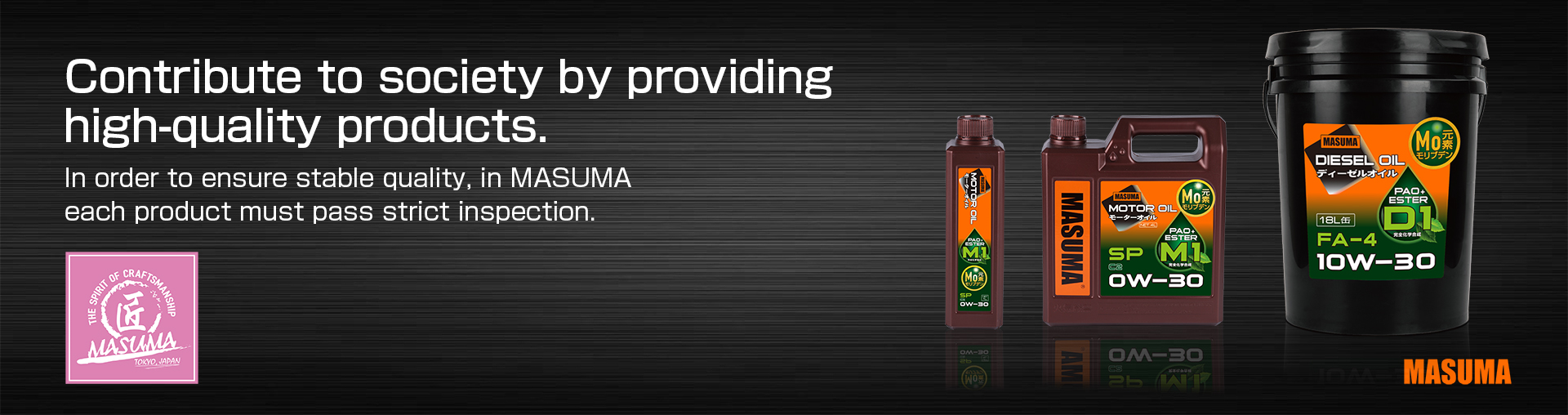
 ENGINE OIL
■ Engine lubricant, also known as engine oil, is composed of base oil and additives, with base oil serving as its main component, Lubricant is featured by its multiple engine-benefiting effects, such as lubrication, abrasion reduction, auxiliary cooling, sealing, rust resistance, corrosion prevention, shock absorption and buffering.

1. Lubrication: Engine lubricant forms an oil film between piston and cylinder, and thereby separates the friction surfaces of both components to reduce friction, which is its most significant function.
2. Detergency: Engine lubricant can bring carbon deposits, oily filth and abraded metal particles from engine components to the oil pan by circulating in the lubrication system.
3. Sealing: Engine lubricant forms an oil film on the friction surfaces of engine components and plays a role in sealing, thereby reducing gas emission and oil leakage, and keeping external pollutants away from entering the engine.
4. Rust resistance and corrosion prevention: The oil film can adhere to component surfaces, thus prevent water, air, acids and harmful gases from contacting those components and avoid oxidative corrosion.
5. Cooling: Engine operation will generate high temperature. Engine lubricant reaches the operating part, absorb the heat and then take it away. Some of the heat from the operating engine is brought back to the lubricant tank and then dissipated away through circulation in the engine lubricant system.
6. Shock absorption and buffering: An starting engine will drive up the cylinder port pressure sharply, and thus increase the load upon piston, piston pin, connecting rod and crankshaft bearing suddenly. As such load is transferred via lubricant, the shock is absorbed and the vibration is reduced by the lubricant that works as buffer.
Classification:
■ Automobile engine lubricants are mainly divided into two kinds, namely mineral lubricants and synthetic engine lubricants; the synthetic engine lubricants can be further divided into fully synthetic engine lubricants and semi-synthetic engine lubricants.
■ From the perspective of composition, fully synthetic engine lubricant contains no mineral lubricants while semi-synthetic engine lubricant contains a small amount of mineral lubricants. Mineral lubricants are refined from petroleum and then mixed with additives, boasting their low costs. Synthetic engine lubricants are synthesized through chemical methods. Despite their high costs, they present a better high-and-low temperature performance and a longer service life than mineral lubricants.

 Main Advantages:
■ Molybdenum boron ester technique: Save fuel, suppress noise and boost power.
■ Low-temperature start performance: Ultra low pour point, easy boot, better product flow, wide range of applicable temperature area.
■ Cleaning and dispersive performance: High-specification products suppress the generation of carbon deposition and the greasy dirt, keep the engine inside clean and effectively save fuel.
■ Viscosity-temperature performance: High-quality base oil delivers better viscosity temperature performance, low variation of viscosity and stable performance, reduces mechanical wear and extends the oil change time.
■ Product Positioning of MASUMA Engine Oil
High quality delivers high performance. In terms of product quality and performance, MASUMA always keeps up with or even surpasses first-line brands like Mobil, Castrol, Shell and Fuchs., and offers high-end products.
Differentiated performance formula: Thanks to 100% imported raw materials combined with unique “molybdenum boron ester” suspending technique, this formula has the features of boosting power, suppressing noise and saving fuel.
Streamlined product line: Characterized by simple and streamlined design, wide coverage, etc., this product takes pressure of inventory off the distributor and satisfies the use requirements of more than 98% of vehicles.
Quality orientation: The product has passed API SP certification and meets ACEA standards or OEM specifications.
■ Source of Raw Materials
Base oil mainly comes from: American Mobil APO, Swiss INEOS PAO, Dutch Shell GTL, Abu Dhabi ADNOC, Korean SK Innovation, S-OIL.

■ Additives: American Afton, British Infineum, American Chevron, American Lubrizol, German RohMax

MASUMA Product classification
 M1 Use of Product Structure and Raw Materials:
■ API SP ACEA C2 0W-30. Considering its medium ash contents, it is more suitable for National VI vehicles with particulate trap. Base oil formula: PAO+Ester, additive: Lubrizol.
■ API SN/CF ACEA A3B4 0W-40. With high ash content, it is suitable for vehicles without particulate trap that fall below the National VI Emission Standard. Base oil formula: PAO+Ester, additive: Afton.
■ API SN/CF ACEA C3 5W-30. Considering its medium ash contents, it is more suitable for National VI vehicles with particulate trap. Base oil formula PAO+group III, additive: Infineum.
 M2 Use of Product Structure and Raw Materials:
■ API SN/ILSAC GF-5 0W-20/0W-30. American standard products are more suitable for American, Japanese, Korean and domestic vehicles. They feature better low-temperature flow performance, more smooth cold start and fuel-saving. Formula: PAO+group III, additive: Afton.
■ API SN/CF ACEA C3 5W-30. With medium ash content, it is more suitable for National VI vehicles with particulate trap. Base oil formula PAO+group III, additive: Infineum.
■ API SN/CF 5W-30. American standard products are more suitable for American, Japanese, Korean and domestic vehicles, as well as light duty diesel engine. Group III base oil, additive: Afton.
■ API SP ILSAC GF-6 5W-30. With medium and low ash content, it is suitable for national VI vehicles. American standard products are more suitable for American, Japanese, Korean and domestic vehicles. Group III base oil, additive: Afton.
■ API SN/CF ACEA A3B4 5W-40. The product with high ash content is suitable for vehicles that fall below the National V Emission Standard. It has long oil change cycle. European standard products are applicable to German car series like Mercedes-Benz, BMW, Audi and Volkswagen, as well as American, Japanese, Korean and domestic vehicles with long mileage. Group III base oil, additive: Afton.
 M3 Use of Product Structure and Raw Materials:
■ API SN ILSAC GF-5 5W-30. The product with medium and low ash content is suitable for national VI vehicles. American standard products are more suitable for American, Japanese, Korean and domestic vehicles. Group III +II base oil, additive: Afton.
■ API SN/CF ACEA A3B4 5W-40 is suitable for vehicles that fall below the National V Emission Standard. It has long oil change cycle. European standard products are applicable to German car series like Mercedes-Benz, BMW, Audi and Volkswagen, as well as American, Japanese, Korean and domestic vehicles with long mileage. Group III base oil, additive: Afton.
■ API SN/CF ACEA A3B4 10W-40 is suitable for vehicles that fall below the National V Emission Standard. It has long oil change cycle. European standard products are applicable to German car series like Mercedes-Benz, BMW, Audi and Volkswagen, as well as American, Japanese, Korean and domestic vehicles with long mileage. Group III base oil, additive: Afton.
Engine Lubricant SP Series
■ SP fully synthetic engine lubricant is of the highest grade among all lubricants currently available on the market. The lubricant adopts the latest generation of organic molybdenum energy-saving formula of MASUMA, allows the engine to present a more stable power and a better acceleration performance and to reduce fuel consumption and noise, and provides better protection for the engine. Besides, it can not only prevent the engine from early ignition at a low velocity, and effectively avoid timing chain abrasion and elongation, but also present corrosion resistance, oily filth generation control and many other excellent features.


Engine Lubricant SN Series
■ Lubricants of SN grade are divided into fully synthetic and semi-synthetic types: The fully synthetic lubricant is featured by its high antioxidant stability, high abrasion resistance, low phosphorus and zinc contents, and reduced three-way catalytic converter loss. SN engine lubricant is mainly improved regarding its high temperature detergency. SN requires an oil ring blockage rate no more than 15% and therefore particularly applies to turbocharged engine. The semi-synthetic lubricant of SN grade is featured by its excellent low-temperature fluidity and effectively reduced cold-starting abrasion; its low evaporation formula technology can effectively reduce engine lubricant consumption, thus presenting a better cost-efficient performance than that of fully synthetic lubricant.


Diesel Engine Lubricant Series
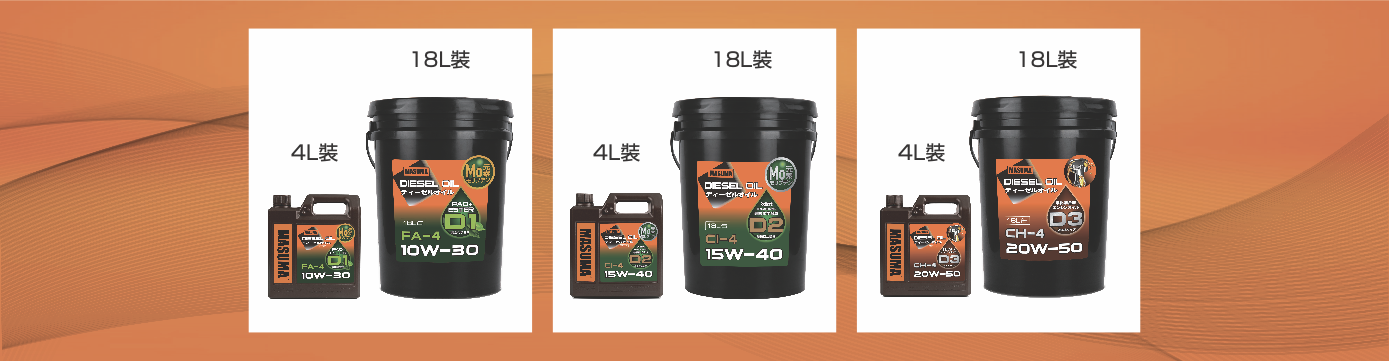
■ Diesel engine lubricants: They are featured by their high-temperature stability, clean dispersion, abrasion resistance, oxidative corrosion resistance, suspended particle reduction, energy conservation, low volatility, etc. They meet the lubrication and protection needs from diesel engines under various operation conditions, provide reliable engine performance and enhance engine service life.
MASUMA Product testing performance
■ MASUMA engine oil performance in four-ball test

■ MASUMA High-Performance Engine Oil 20,000 Kilometer Driving Test
MASUMA M1 OW-40 shows excellent sludge and carbon deposit control ability and superior wear protection performance in Mercedes-Benz 20,000km test.

■ MASUMA engine oil sludge performance
MASUMA fully synthetic engine oil program VG engine oil sludge rating 9.6, 20% higher than SN/GF-5 requirement of 8.0, also meeting SP grade requirement of 9.0, indicating Masuma engine oil has superior sludge control ability.

■ MASUMA engine oil gelling plate anti-oxidation performance test
MASUMA gelling plate test is level 2, showing excellent anti-oxidation performance and longer oil change intervals.

■ MASUMA engine oil M2 fuel economy performance
M2 5W-30 shows excellent fuel economy with a result of 4.3 in the Daimler M111 Fuel Economy test.

■ MASUMA engine oil noise reduction performance
MASUMA 0W-20 decibel test result is 74, showing good noise reduction performance, mainly due to the noise reduction effect of molybdenum boron ester suspension technology.


1. Good low-temperature fluidity: They are the mixture of the most quality base oils currently available and the advanced additive formulas so as to meet the demanding operation requirements for automotive engines.
2. Environmental friendliness and energy conservation: They contribute to environment protection, save fuel and reduce exhaust emissions significantly.
3. Extended lubricant replacement period: They are featured by their good oxidation stability, less oily filth and deposition, extended lubricant replacement period, and less waste lubricant discharge.
4. Excellent abrasion resistance: They adopt the advanced abrasion-resistant formula, and allow the oil film to protect piston, piston ring, ring groove and other components all the time, so as to keep the engine always in good operation conditions.
5. High-temperature stability: They are featured by their good shear stability at a high temperature, and a lower evaporation loss than conventional lubricants, thus reducing engine lubricant consumption.

■ It is appropriate for vehicle owners to keep the lubricant filling amount between the upper and the lower scales of the dipstick because the excessive lubricant will escape into the combustion chamber from the gap between cylinder and piston and thus form carbon deposits that will increase the engine compression ratio and step up the knock tendency. Moreover, the carbon deposits in a red hot state in the cylinder is likely to trigger early ignition. The deposits in the cylinder will not only aggravate the abrasion of both cylinder and piston, but also accelerate the lubricant contamination. In contrast, inadequate lubricant will accelerate the abrasion inside engine.
■ High-quality lubricants are finished products with multiple engine protection functions and various additives in their formulas, including abrasion-resisting agents; moreover, what lubricants emphasize the most is a balanced formula for guaranteed and full exertion of various features. An unauthorized addition of other additives will not only fail to bring additional protection to your vehicle but also enhance the probability for the additives to react with those chemical substances in the engine lubricant, thus resulting in the decline in comprehensive lubricant performance.

■ After the long operation of engine, many impurities will accumulate in the engine lubricant filter and the gasoline filter, resulting in an insufficient gasoline combustion, a declined fuel efficiency and an increased fuel consumption; therefore, vehicle owners ought to develop a good inspection habit, and check your engine lubricant carefully for timely replacement during your daily maintenance according to different driving conditions.