





 English

New Arrivals












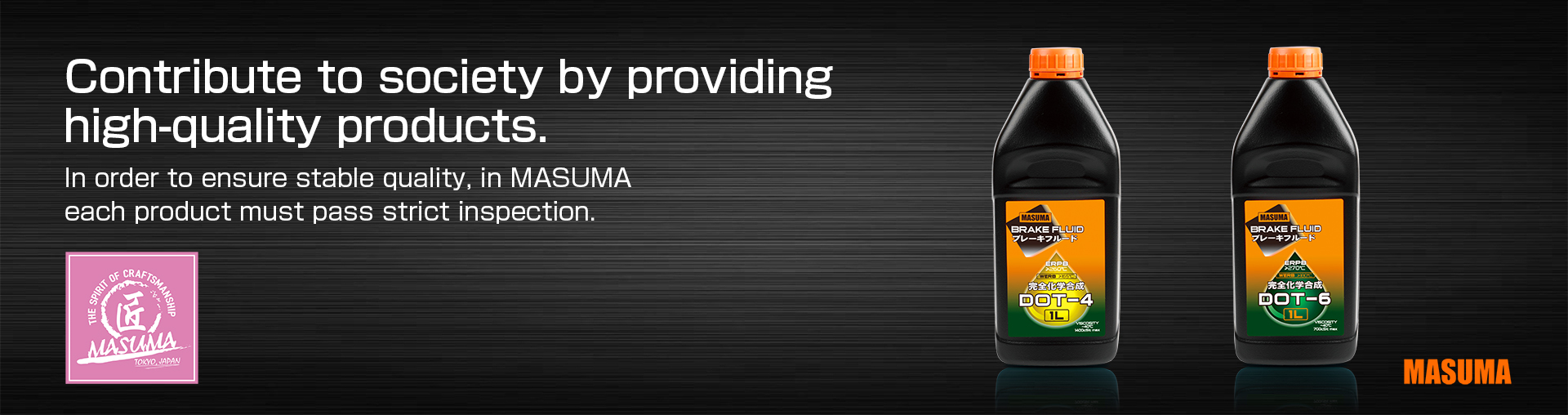
 BRAKE FLUID
■ Brake fluid, also named as “automotive brake fluid or braking fluid”, works as a kind of fluid that transmits pressure in a hydraulic brake system to stop vehicle wheels from rotating. Brake fluid serves as a liquid medium that transmits the brake pressure in a hydraulic brake system. Since liquid cannot be compressed, the pressure from the brake master cylinder will be directly transmitted into the wheel cylinder via brake fluid which thus become a crucial security component in the brake system.

Relevant DOT/BF/HZY Criteria
■ DOT is the criteria widely adopted now by developed regions, such as the United States and Europe; BF is the criteria adopted by Japan; HZY is the criteria adopted by China.Brake fluid is roughly divided into three categories: DOT3, DOT4 and DOT6. Among them, DOT3 and DOT4 are the most common brake fluid levels used in automobiles in various countries. HZY is formulated as per GB12981-2012 Motor Vehicle Brake Fluids of China that divides brake fluid into HZY3, HZY4 and HZY6, corresponding to DOT3, DOT4 and DOT6, respectively, in the international community.


■ Please go to an official garage for brake fluid replacement. Incomplete exhaust or bubble hybrid during the brake fluid replacement may extend your vehicle's braking distance and thus entail another exhaust or replacement.Brake fluid must be used up once it is unsealed, and not be preserved for a second replacement.

Operation Principle of Brake System
■ Brake fluid fills the reservoir and the fluid pipeline. When we press the brake pedal, the force pushes the master cylinder piston through brake push rod; then, the force is transmitted via brake fluid to the wheel cylinder piston; it compresses the friction plate to the brake disc; thus, the friction between brake plate and brake disc gives rise to the braking effect (In the situation of disk brake); alternatively, it pushes the brake shoe outward and produces the braking effect through friction between brake shoe and brake wheel (In the situation of drum brake). Brake fluid formulas are generally divided into 3 types:
1. Castor oil-alcohol type: It is made from the 45%-55% of refined castor oil and the 55%-45% of low-carbon alcohol (Ethyl alcohol or butyl alcohol).
2. Synthetic type: It is made from ether, alcohol, ester, etc., mixed with some additives with lubrication, anti-oxidation, anti-rust, anti-rubber swelling and other features.
3. Mineral oil type: It is made from refined light diesel oil fractions mixed with viscosifier and other additives.
Brake fluid works as a kind of functional fluid that transmits pressure in a hydraulic brake system to stop vehicle wheels from rotating. Its working brake pressure is 2 MPa in general or as high as 4-5 MPa. Due to the incompressible feature in all liquids, as liquid is under pressure in a sealed container or a liquid-filled pipeline, the pressure will be transmitted to all parts of the liquid in a fast and uniform manner.

1. The product is featured by its high boiling point; the flexible transmission of braking force must be ensured under high temperature, cold, damp and hot and other working conditions; the product improves the resistance of braking system against air resistance, achieves a greater braking efficiency and a wider range of working temperatures, and generates no air resistance at a high temperature.
2. The product is featured by its low viscosity (high fluidity); such a low viscosity ensures the rapid response capacity of ESP, results in a more stable performance of electronic brake control system (ABS, ESP, ACR, TCS, etc.), and endows the product with a more direct pedal response, a good viscosity-temperature characteristic, a low freezing point and a low temperature fluidity.
3. The product is featured by its resistance against corrosion and oxidation and its protection for brake system components, and thus keeps the full integrity of whether rubber or metal; it sees a little quality change during its service, and will not corrode and deteriorate metal and rubber components in the brake system.
4. The product is featured by its extraordinary equilibrium reflux boiling point, wet equilibrium reflux boiling point, kinematic viscosity, pH value, liquid stability, corrosion resistance, low temperature fluidity, appearance, evaporation performance, water capacity, liquid compatibility, oxidation resistance, rubber compatibility, stroke simulation performance and rust resistance.
5. The product can lubricate the moving components of brake system, and extend the service life of wheel cylinder and leather cup, effectively.Product (Schematic diagram on working mechanism)

■ Brake fluid is of water absorption property. Therefore, as the moisture in the brake fluid increases, the boiling point of brake fluid will decrease substantially; a brake fluid with a low boiling point is prone to boiling and generating bubbles before reaching its boiling temperature, thus hindering the force transmission and resulting in longer braking distance.

Why is Regular Brake Fluid Replacement Necessary?
■ Moisture Absorption and Deterioration
Brake fluid is inherently hygroscopic, meaning it continuously absorbs moisture from the air. Excessive moisture content can lead to brake failure, posing serious safety risks.
■ Lowered Boiling Point
Increased moisture content significantly reduces the fluid's boiling point. During aggressive driving or on long downhill slopes, high temperatures can cause the fluid to boil, resulting in vapor lock. This prevents proper transmission of braking force, leading to impaired braking performance.
■ Vapor Lock Formation
When brake fluid boils, bubbles form within the system. Since gases are compressible, this leads to a spongy or sinking brake pedal feel, increased braking distance, or even a complete loss of braking response.
■ Corrosion of Components
Prolonged use without replacement allows the fluid to become acidic, corroding metal and rubber parts within the brake system. This can cause seizing, fluid leaks, and costly repairs.
Precautions for brake fluid utilization
■ Brake fluid works as a crucial component of automobile brake system and concerns the personal safety of vehicle owner. For this reason, the 3 tips below shall be followed as we utilize the brake fluid:
1. Brake fluid with water or impurity inside shall be replaced in time; otherwise, it will reduce the brake pressure and compromise the brake performance.
2. Brake fluids of different types and with different brands shall never be mixed for service. Due to their different formulas, brake fluid hybrid will lower brake fluid indexes.
3. When a vehicle sees a biased brake, an overhaul to the brake system is necessary. An over expanded leather cup indicates the problematic quality in brake fluid.At this moment, the brake fluid shall be replaced by one with a better quality, and the wheel cylinder shall be replaced simultaneously.

■ In general driving conditions, brake fluid shall be replaced after it is used for each two years or 50,000 km because there will be boiling point reduction, contamination and oxidation deterioration at different degrees after brake fluid serves for a certain period of time. For this reason, the quality and performance of brake oil shall be checked for replacement timely based upon environmental conditions, seasonal changes and working conditions; as for its replacement, a professional automatic brake fluid changer should be a good option.