





 English

New Arrivals














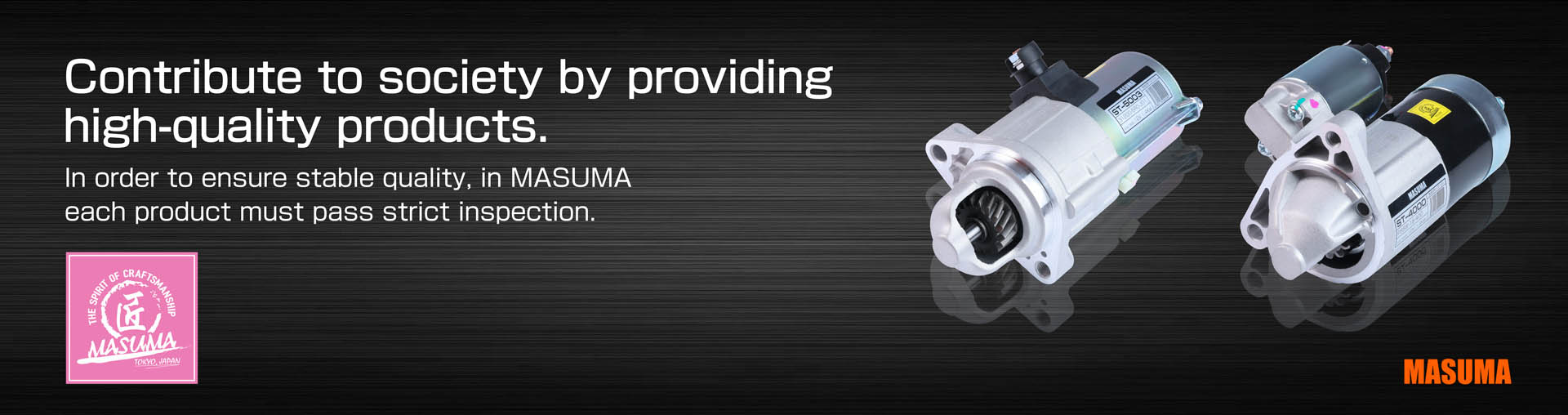
 STARTER
■ The starter can convert the electrical energy from the battery into mechanical energy, and drive the flywheel to rotate to start the engine. Before the engine runs on its own power, it needs external force to rotate. The process by which the engine transitions from a static state to being able to run on its own with the help of external forces is called the start of the engine. More generally, the starter completes the whole starting process with three parts. The DC motor introduces current from the battery and causes the driving gear of the starter to produce mechanical movement; the transmission mechanism engages the driving gear into the flywheel ring gear and can automatically disengage after the engine is started; the starter circuit is switched on and off by an electromagnetic switch.


■ The starter has passed the EU ROSH certification and its performance degradation rate in extreme cold weather is less than 5% (grater than that specified in the national standard). Operating decibel is lower than the national standard and it can be quickly started under high power. Aluminum alloy is the general term for alloy that uses aluminum as the main material and a light metal, so the rotor of the engine and starter of vehicles is usually made of aluminum alloy materials. However, the starter brush holder are mostly made of graphite or coper-containing graphite in order to enhance electrical conductivity. Graphite offers good electrical conductivity, soft texture and wear resistance.
■ Main components: Carbon brush holder, rotor coil, stator coil, rectifier voltage regulator and terminal.
■ Role of each component:
1. Carbon brush holder: To feed external power supply to the rotating rotor coil;
2. Rotor coil: After being energized, it will produce a magnetic field to achieve magnetism production by electricity and induction of the stator coil;
3. Stator coil: To receive the magnetic field induced by the rotor coil to achieve electricity generation by magnetism;
4. Rectifier: Change the alternating current generated by the stator to direct current output;
5. Voltage regulator:To adjust the electric-power output of the generator by controlling the current of the rotor coil, so as to keep electric-power output within a stable range, ensuring that the electrical appliances of whole vehicle have stable working voltage.
6. Terminal: Responsible for external power input and internal power output.
■ DC motor is composed of DC series motor, control mechanism and clutch mechanism. It is specially used to start the engine and requires strong torque, so the current reaches to hundreds of amps.
■ DC motor provides high torque at low rotation speed and the torque turns smaller and smaller gradually at high rotation speed. This makes it very suitable for starter. The starter uses DC series motor, and both rotor and stator are wound with thicker rectangular-section copper wires; the driving mechanism adopts reduction gear structure while the control mechanism applies electromagnetic method.

■ The engines are usually started manually, with auxiliary petrol engine or electrically. To start the engine manually, rope-pulling or hand-cranking method is used, simple but not convenient. In some vehicles, it is only kept as a backup; starting the engine with petrol engine is mainly applicable to high-powered diesel engines; compared with them, electric starter is easy to operate, guarantees rapid start, repeated start ability and supports remote control, so it is widely used in modern automobiles.
1. Compact structure and small volume.
2. High torque, six-pole magnetic tile, planetary reducer with reduction ratio up to 6.857.
3. More stable magnetic properties, high residual flux density.
4. Environment-friendly components, zinc-nickel alloy electroplated rear cover of case with better salt spray resistance.
5. Pure original component, 100% factory inspection, long service life, high durability.
Electromagnetic switch: The electromagnetic switch is more compact, the output force decreases after the gear head of isolator is separated from the curved disk. Meanwhile, the single terminal structure is adopted.
Armature assembly: It is responsible for converting electrical energy into mechanical energy by cutting the magnetic field and providing torque. Made of silver copper, the commutator is more durable.
Isolator assembly: Engaging with the flywheel, it carries over torque unidirectionally. Compared with traditional isolators, it guarantees faster and more stable engagement.
Working Principle of Starter

■ The starter is a mechanical and electrical integrated product to achieve energy conversion. Electric energy is converted into magnetic energy and then converted into mechanical energy (the result of the magnetic field interaction of the stator and rotor is the armature reaction process) while the starter rotates to output torsion.
■ When the ignition switch is closed, two coil windings are powered. Due to lower resistance and large current, pull-in winding is connected with the motor circuit in series. Under the action of the current, the motor rotates slowly to facilitate the engagement of pinion gear with the flywheel.
■ P (Power)=M (Torque)×n(Rotation speed)× µ(Factor)
■ The starter achieves the transmission of torque through the engagement of gear with flywheel, and thus drives the engine to reach to the normal speed of ignition. After the starter is powered off, the gear automatically disengages from the engine flywheel. At this time the engine ignites and enters normal operation, and the starter stops working.




Maintenance Tips
■ The starter is a valuable part of vehicles and will not be damaged easily. However, proper use is also necessary in order to extend the service life of the starter. In the process of starting the engine, the starter should introduce 300 to 400 As (amps) of electricity from the battery, so in order to prevent the battery from overcurrent or damage, the starting time should not exceed 5s; in winter, it’s difficult to start the engine. If multiple starts are required, each starting time should not be too long, and appropriate intervals should be kept.