





 English

New Arrivals
















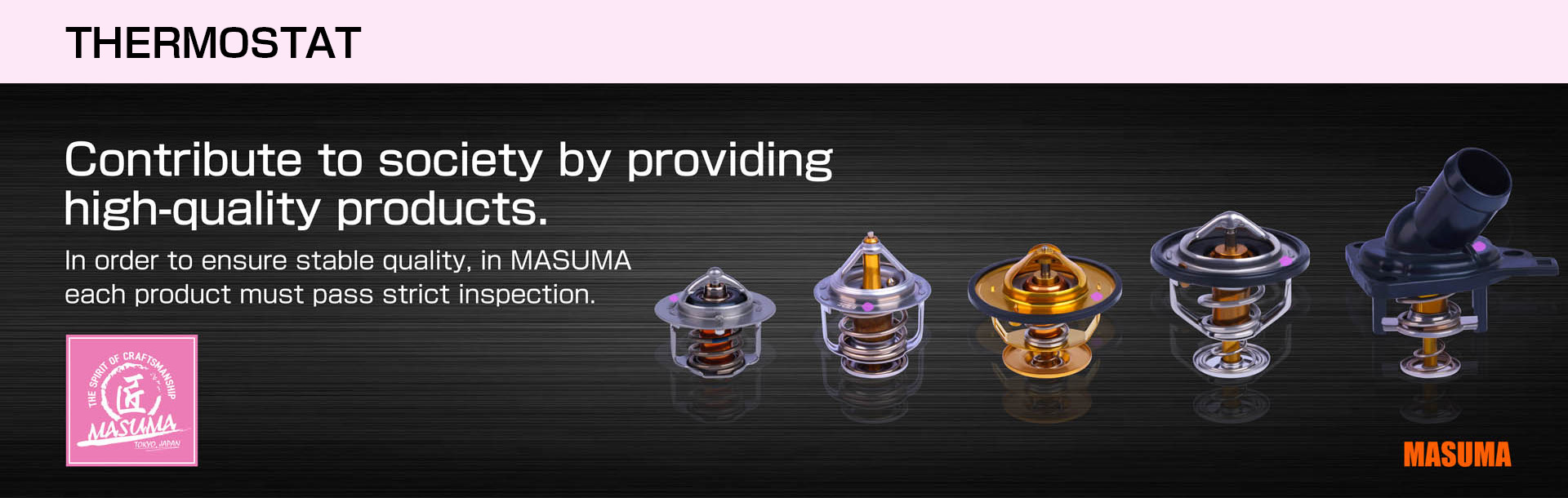
 THERMOSTATS
■ A Thermostat is an automatic temperature control device, usually containing a temperature-sensitive component, which turns the flow of coolant on and off by means of expansion or contraction, i.e. automatically adjusts the flow rate into the radiator according to the temperature of the coolant and changes the circulation range of the coolant in order to regulate the cooling system's cooling capacity.
■ The thermostat used in engines is mainly a wax thermostat, which is controlled by the internal paraffin wax through the principle of thermal expansion and contraction. When the cooling temperature falls below the specified value, the refined paraffin wax inside the thermostat is solid and the thermostat valve closes the passage between the engine and the radiator under the action of the spring, and the coolant returns to the engine via the water pump for a small engine circulation. When the coolant temperature reaches the specified value, the paraffin wax starts to melt and gradually turns into liquid, the volume then increases and presses the rubber tube to make it shrink, while the rubber tube shrinks, it acts as an upward thrust to the push rod, which has a downward counter-thrust to the valve to make it open. At this point the coolant flows through the radiator and thermostat valve and then back to the engine via the water pump for a large circulation.

■ The thermostat is mostly arranged in the cylinder head outlet pipe, which has the advantage of being simple in construction and easy to drain air bubbles from the cooling system.
■ The role of the thermostat is to close the car before the temperature reaches the normal temperature, at which time the engine coolant returns to the engine via the water pump for a small circulation within the engine, which plays a role in allowing the engine to warm up quickly. When the normal temperature is exceeded, it can be opened, so that the coolant through the entire radiator circuit of the water tank for large circulation, so as to quickly dissipate heat, in order to prevent the ventilation hole blockage, some add a pendulum.


1. The gland is made of H62 or H65 brass, which has good mechanical properties and high strength, good plasticity in hot and cold conditions, and can also withstand cold and hot pressure and corrosion resistance.
2. The wax pellets inside the thermostat are made of refined paraffin wax, which is the common name for a mixture of solid senior alkanes with the molecular formula CnH2n+2, where n=20~40. In order to improve thermal conductivity, the paraffin wax is often mixed with copper powder.
3、 The seal uses natural rubber from Thailand, which is resistant to ageing, oil and corrosion, and has excellent sealing performance no matter at low or high temperature.
4. 430 steel is used for the push rod, valve base, valve, bracket, sub valve and gasket, and stainless steel 304 is used for the sub spring, which has the performance of anti-oxidation and corrosion resistance.
Testing Introduction
1. Temperature testing.
2. Vibration testing.
3. Environmental testing.
4. Performance testing.
5. Durability testing.
6. Spectral analysis.
7. Cleanliness testing.



■ Generally speaking, the coolant temperature can reach 85~105 degrees normal temperature about five minutes after the car starts cold, if it does not reach normal working temperature for a long time, or the temperature rises straight up over 110 degrees, you should suspect whether the thermostat is faulty.
A. Coolant temperature over 110 degrees: stop the engine, open the engine lid, use an infrared thermometer to measure the upper water (liquid) tube in the coolant radiator, the tube should be very hot. Then use the infrared thermometer to measure the lower radiator water (liquid) pipe, it should also be very hot, if there is a large temperature difference between the upper and lower pipes, it is determined that the thermostat is faulty.
B. If it has not reached the normal working temperature for a long time: stop and let the engine temperature drop to the same temperature as the air temperature, and then start the engine, see the dashboard temperature rise to about 70 degrees (not to more than 80 degrees), stop the engine to open the engine lid, use the infrared thermometer to measure the radiator upper and lower water (liquid) pipe, if there is no temperature difference, it is determined to be a thermostat failure.
C. With infrared thermometer near the thermostat detection method: aim at the thermostat housing, test the thermostat inlet and outlet temperature changes, you can determine whether the thermostat open, the engine starts, the inlet temperature will increase, at this time the thermostat off. When the water temperature gauge reaches 70 degrees, test the temperature of the water outlet, it will suddenly increase, at this time, observe the temperature of the water temperature gauge should be above 80 degrees, indicating that the thermostat is open and working normally, if the temperature does not change, indicating that the thermostat is not working well and needs to be replaced.
D. The safe life of wax thermostat is generally 50,000km driving mileage, so it is required to be replaced regularly according to its safe life.