





 English

New Arrivals









 BRAKE SHOE
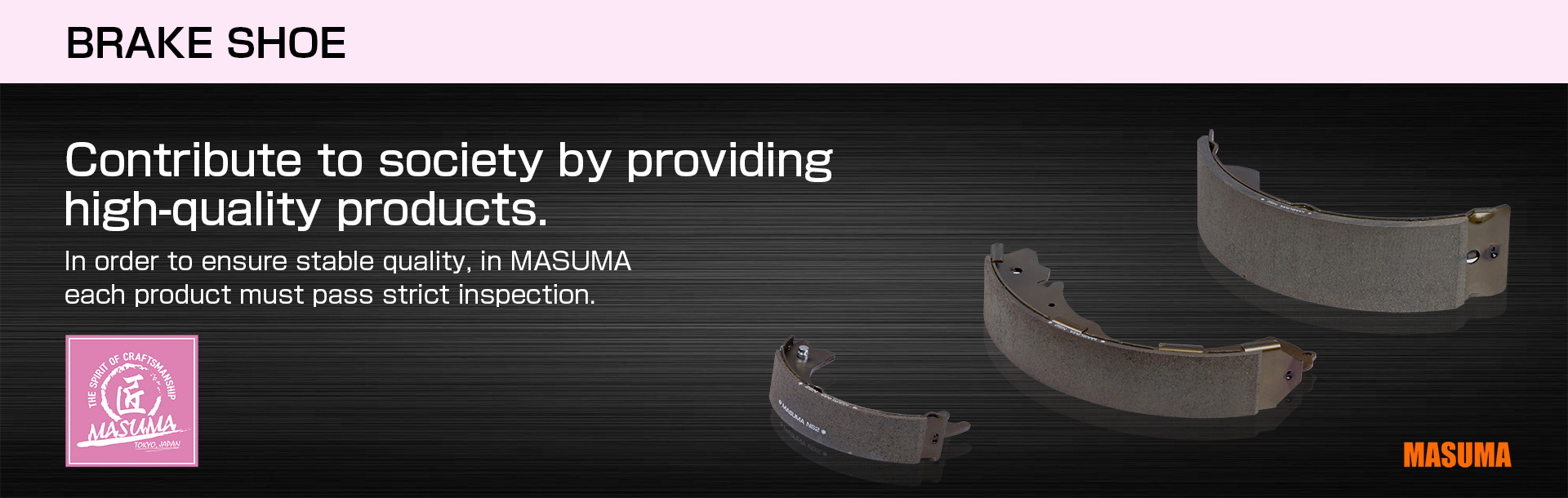
■ The brake shoe is one of the critical safety components in an automotive braking system. It is installed inside the brake drum and is shaped like a crescent.
■ Brake shoes are categorized as leading shoes or trailing shoes based on whether their direction of rotation when expanding aligns with the rotation direction of the brake drum. When the rotation direction of the expanding shoe matches the drum's rotation, it is called a leading shoe, which has a self-energizing effect and is also known as a "self-energizing shoe." Conversely, it is called a trailing shoe, or a "non-energizing shoe."
■ Generally, the effectiveness factor of a leading shoe is about three times that of a trailing shoe. In servo brakes, the effectiveness factor of the secondary leading shoe (the shoe which is expanded via a linkage from the primary leading shoe) is also approximately three times that of the primary leading shoe (the shoe expanded directly by the wheel cylinder piston).

■ The brake shoe is connected to the axle via the brake backing plate and remains stationary, while the brake drum rotates with the wheel. During braking, the brake shoe is pressed against the brake drum by the brake actuation mechanism, using friction to decelerate the wheel. For passenger cars and light/mini trucks, brake shoes are typically manufactured from T-section steel or stamped-welded steel plate. For heavy-duty trucks (medium-duty and above), materials such as malleable cast iron, ductile iron, cast steel, or cast aluminum alloy may be chosen, with cross-sectional shapes like I-beam or modified I-beam to ensure sufficient rigidity.
■ Brake shoe support methods include fixed and floating types:
Fixed/Pivoted Support: The lower end of the shoe has a round (or semi-circular) hole that fits over an anchor pin, allowing it to pivot freely. This method, used mostly in medium and heavy-duty vehicles, offers robust construction and stable operation but requires higher machining precision.
Floating Support: The lower end of the shoe has a curved surface that rests against a support, allowing it to both pivot and slide vertically (two degrees of freedom). This provides good self-centering and has relatively lower requirements for machining precision, making it common in passenger cars and micro/light vehicles.
Working Principle of Brake Shoes
■ When the brake pedal is depressed, the two crescent-shaped brake shoes are forced outward by hydraulic pressure from the master cylinder. The shoes press against the inner wall of the brake drum, creating friction to decelerate or stop the vehicle. This is the principle of drum brakes. The predominant design is the internally expanding type, where the brake shoes are mounted inside the drum and expand outward against its inner surface to generate braking force.

■ MASUMA is equipped with a comprehensive brake shoe production line, integrating automation and precise control for a smooth, efficient process. Every production stage is under strict control, ensuring reliable product quality. For the friction linings, we employ a mature NAO high-performance ceramic formula, processed via precision compaction. This enhances braking performance while delivering excellent durability and stability.
■ Eco-friendly Material: NAO high-performance ceramic formulation boosts braking efficiency with minimal environmental impact.
■ Stable Braking: Provides consistent braking performance with high cost-effectiveness and practicality for more economical driving.
■ Durable & Long-lasting: The mature formulation combined with stable production processes ensures a longer service life.
■ Full-process Quality Control: Strict quality control is implemented at every stage, from raw material procurement to finished product shipment, ensuring consistently stable and reliable quality standards.




Failure Symptoms of Worn/Damaged Brake Shoes
■ Failure symptoms primarily include the following:
Excessive brake pedal travel, causing a delayed response, significantly reduced braking power, or total brake failure, which increases stopping distances.
Insufficient brake fluid pressure, possibly due to low fluid in the master cylinder, ruptured brake lines, leaking pipe connections, or blocked fluid passages.
Air in the brake hydraulic system, which compromises braking effectiveness.
Excessive brake pedal free play or excessive brake shoe clearance, poor contact of the shoe linings, severe wear, or contamination (oil/grease), all affecting braking performance.
Wear or scoring of the piston and bore in the master or wheel cylinders, or aging/damage of rubber seals (cups), which is a common cause of reduced braking efficiency.
These symptoms directly impact the vehicle's braking performance and require prompt repair or replacement to ensure driving safety.

■ Method for inspecting and adjusting brake shoe assemblies:
1. Checking Brake Shoe Clearance: Before checking clearance, first inspect the thickness of the friction linings. This can often be done through an inspection hole on the wheel's brake backing plate.
2. When the friction lining thickness is less than the specified value, it indicates the lining has reached its wear limit. The vehicle should be serviced to replace the brake shoes. For some small vehicles, when the pointer at the brake adjuster reaches the "END" mark, the brake shoes should be replaced.
3. Jack up the wheel being inspected so it can rotate freely. Firmly press on the tire tread with both hands to check for wheel bearing looseness. If looseness is detected, it should be adjusted first.