





 English

New Arrivals













 Ball cage
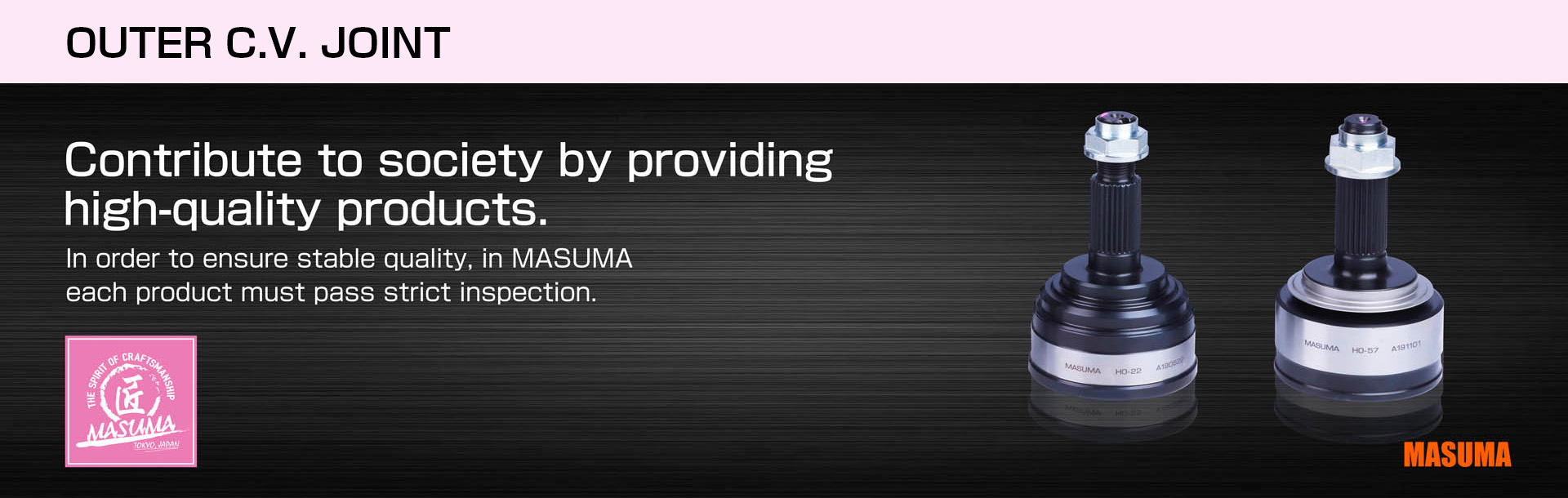
■ The inner ball cage is connected to the differential section of the gearbox casing and the outer ball cage is connected to the wheels. It is the outer ball cage that affects both the performance and turn-in of the car. The car ball cage is divided into the inner ball cage and the outer ball cage, also referred to as the “constant velocity universal joint”. It is an important part of the car transmission system, and its function is to transmit the engine power from the transmission to the two front wheels and keep the car driving at high speed. The car ball cage generally consists of a bell cup, a trident bearing or steel ball, a dust cover, a bundle ring and grease.


■ Outer CV joint: Its steel balls are fixed in the six windows of a cage between the inner race and the outer race, and the steel balls take up exactly half the space of the inner race and the outer race to determine the angle of action with the universal joint. Smooth surface makes the universal joint move like helical gear, and each of the six balls drives the lane in the inner race and the outer race, but the torque is delivered through the ball rather than the gears.
■ Inner CV joint (Tripod bearings): Tripod constant velocity universal joint doesn’t have steel balls inside, but uses three needle bearings, which can slide in the three rails inside the outer race. The inner CV joint that is mainly applied to four-wheel drives is suitable for the position of inner CV joint with small angle of torsion, and can slide inwards and outwards to accommodate changes in the length of the drive shaft as the vehicle moves.
■ Inner CV joint (Six balls): This sliding constant velocity universal joint presents different design concept. Inside it steel balls are used to deliver torque. Compared to TJ inner CV joint, it shows excellent performance and requires shorter sliding distance, solving the problem of noise. So this inner CV joint is widely used in four-wheel drive vehicles.


1、 Heat treatment: the product shell, star sleeve and cage are all automatic heat treatment, normalized blank organization grade 1, grain size grade 8; quenched surface martensite organization grade 3
2、 Accessories: steel balls grade G16, and the shell is made of high quality steel No. 55.
3、 Machining accuracy: eccentric distance ±0.01mm, ball track approximation 1.004 times, ball contour ≤0.013mm, ball track by grinding method, brightness 0.4 um.
4、 Experimental guarantee: fatigue life test over 250,000 cycles, cage 100% defect detection test.
5、 Production process: lathe, milling, grinding, and assembly processes are completely automated.
6、 Product inspection: All products are inspected in accordance with the corresponding Japanese standards.




1. When driving on bends or rough roads, you may hear a periodic “chugging”.
2. Observing the dust sleeve of the ball cage with the naked eye, the dust sleeve appears to be damaged or leaking oil. The lubricating grease in the dust sleeve is specifically designed to reduce wear of the ball head, so if there is oil leakage, the lubricity will be reduced, the ball head will wear more and the gap will become larger, and abnormal noise will also be produced occur.
■ Besides the above mentioned symptoms, the vehicle can be lifted up for inspection and disassembly if necessary to judge. After the vehicle is lifted, hold the half-shaft by hand, and then turn it back and forth with great force, and if an obvious gap can be felt, it means that the ball cage is worn rather heavily. Alternatively, remove the half-shaft and check whether there is excess clearance in the ball cage, and if there are sand and stones in the ball cage, timely replacement should be carried out, or else it will have serious impact on the whole transmission system.
Maintenance Description
1. Remove the half-shaft lock nut.

2. Lift the car on the lifting machine.
3. Unscrew the six fixing bolts of the inner ball cage.

4. Disassemble the control arm ball head from the steering knuckle.
5. Take off the half-shaft from the side of the outer ball cage. Do not damage the half-shaft dust cover when taking it off.

6. ① Unclamp both sides of the ball cage dust cover, take off the ball cage dust cover and check to see if the dust cover is broken and aging.
② Remove the circlip: the circlip is mounted on the outside of the ball cage, with the external circlip pliers expand the circlip to remove the outer ball cage.
③ Circlip is mounted on the inside of the ball cage. Strike the outer seating ring of the ball cage with a hammer to separate the ball cage from the half shaft.
7. Decompose the ball cage
Strike the inner seating ring of the ball cage with a copper hammer to keep the ball cage and the inner seating ring vertical to the outer seating ring. Remove the inner seat ring, ball cage and steel ball.
8. Ball cage assembly inspection:
Clean the ball cage inner and outer seat ring and steel ball. And inspect the inner seat ring, ball cage, outer seat ring wear, in case of grooves, spalling, spots and other wear, replace the ball cage assembly.
9. Install the outer ball cage:
Apply a small amount of ball cage oil on the inner and outer ball cage raceway first, then install the inner seat of the outer ball cage with chamfered side and the side of the ball cage with chamfered side in the same direction, both are installed vertically into the outer seat, as well as the six steel balls installed on the ball cage at intervals respectively. Push the ball cage, inner seat ring and steel ball into the outer seat ring, noting that the side of the ball inner seat ring with chamfer and the side of the ball cage with chamfer face the large end of the outer seat ring, and make fill the ball cage filled with ball cage oil following installation.
10.Install the inner ball cage:
Apply a small amount of ball cage oil on the inner and outer ball cage raceway first, and then make the large side of the inner seat ring face the small side of the outer seat ring. Then the inner seat ring and the cage are both vertically installed into the outer seat ring, finally, the inner seating ring of the ball cage with chamfered side and the opposite side of the outer ball cage with uneven end face are installed into the outer ball cage, and the ball cage is filled with ball cage oil following installation.
11.nstall the outer ball cage dust cover:
Install the dust cover at the specified location on the half-shaft and secure the dust cover to the half-shaft with a new small clamp.
12.Installing half-shafts:
When mounting the inner circlip type half-shaft, slightly force the half-shaft into the inner seat ring of the outer ball cage, enabling the circlip to be stuck in the half-shaft ring groove to guarantee reliable fixation. When mounting the outer circlip half-shaft, replace the new circlip according to the regulations, and then strike the outer ring with a copper hammer to enable the circlip to cross the inner seat ring.
13.Secure the ball cage dust cover to the outer seat ring with a larger clamp.